|
QuantiChromTM Chloride Assay Kit (DICL-250)
Quantitative Colorimetric Chloride
Determination at 610nm
DESCRIPTION
Chloride is the major extracellular anion in
human body fluids. Chloride plays a key role in maintaining
proper water distribution, osmotic pressure and electrolyte
balance. Low chloride concentrations may be found with prolonged
vomiting, extensive burns, metabolic acidosis, Addisonia crisis
and renal diseases. Elevated chloride concentrations are
associated with dehydration, congestive heart failure,
hyperventilation and urinary obstructions. Determination of
chloride in sweat is useful in diagnosing cystic fibrosis.
Simple, direct and automation-ready procedures for measuring
chloride concentration in biological samples are becoming
popular in Research and Drug Discovery. BioAssay Systems'
chloride assay kit is designed to measure chloride directly in
biological samples without any pretreatment. The improved Fried
method utilizes mercuric 2,4,6-tripyridyl-s-triazine, which
forms a colored complex specifically with chloride. The
intensity of the color, measured at 610nm, is directly
proportional to the chloride concentration in the sample. The
optimized formulation substantially reduces interference by
substances in the raw samples.
KEY FEATURES
Sensitive and accurate .
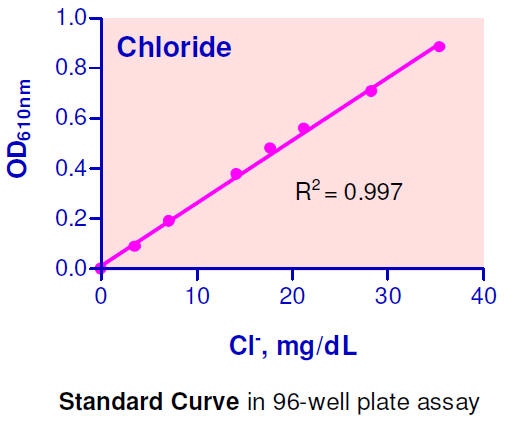
Use as little as 5 μL samples. Linear detection range 0.7 mg/dL
(0.2mM) to 35 mg/dL (10mM) Cl- in 96-well plate assay.
Simple and high-throughput. The procedure
involves addition of a single working reagent and incubation for
5 min. Can be readily automated as a high-throughput assay for
thousands of samples per day.
Improved reagent stability and versatility.
The optimized formulation has greatly enhanced reagent and
signal stability. Cuvet or 96-well plate assay.
Low interference in biological samples.
No pretreatments are needed. Assays can be directly performed on
raw biological samples i.e., in the presence of lipid, protein
and minerals such as magnesium, iron and zinc.
APPLICATIONS
Direct Assays:
Cl- in serum,
plasma, urine, saliva, sweat etc.
Drug Discovery/Pharmacology: effects of
drugs on chloride metabolism.
Food and Beverages: chloride
determination.
Environment: chloride determination in
water and soil.
KIT CONTENTS (250 tests in 96-well plates)
Reagent: 50 mL Chloride standard: 1 mL 35
mg/dL Cl-
Storage conditions .
The kit is shipped at room temperature. Store Reagent and
Standard at 4°C. Shelf life of at least 6 months (see expiry
dates on labels).
Precautions: reagents are for research
use only. Normal precautions for laboratory reagents should be
exercised while using the reagents. Please refer to Material
Safety Data Sheet for detailed information.
PROCEDURES
Important:
bring reagents to
room temperature and shake well before use.
Procedure using 96-well plate:
1. Dilute standards in distilled water as
shown in the table. Serum, plasma, urine and milk samples should
be diluted 20-fold in water. Transfer 5 μL diluted standards and
samples to wells of a clear
bottom 96-well plate. Store diluted standards
at 4°C for future use.
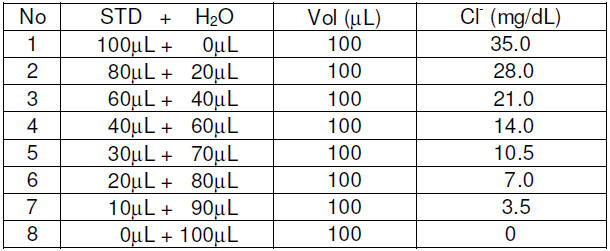
2. Add 200 μL working reagent and tap lightly
to mix.
3. Incubate 5 min at room temperature and
read optical density at 610 nm (550-650nm nm).
Procedure using cuvette:
1. Set up test tubes labeled Standards and
Samples. Transfer 10 μL diluted standards and samples to
appropriately labeled tubes.
2. Add 1000 μL working reagent and vortex to
mix. Incubate 5 min, transfer to cuvet
and read OD at 610nm.
CALCULATION
Subtract blank OD (water, #8) from the
standard OD values and plot the OD against Cl- standard
concentrations. Determine the slope using linear regression
fitting. Chloride concentration of the sample is calculated as

ODSAMPLE and ODBLANK are
OD610nm values of sample and sample blank (water or buffer in
which the sample was diluted). n is the dilution factor (n
= 20 for serum, plasma, milk, urine).
Conversions: 1 mg/dL Cl- equals 282 μM,
0.001% or 10 ppm.
MATERIALS REQUIRED, BUT NOT PROVIDED
Pipeting devices and accessories (e.g. 5 μL),
clear flat-bottom 96- well plates and plate reader, or
spectrophotometer and cuvets.
EXAMPLES (96-well plate assay):
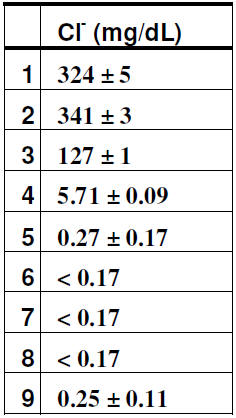
Biological Samples: 1. Human serum. 2.
Fresh human urine. 3. Commercial 2% reduced fat milk (Kirkland).
Water samples: 4. Tap water (Hayward, CA).
5. Tap water (San Bruno, CA). Food and
Beverages: 6. Crystal Geyser natural alpine spring water. 7.
Coca-cola® classic coke. 8. Lipton Lemon iced tea.
Environmental: 9. Soil extract. 5.6 g
of soil (Hayward, CA) was extracted with 10 mL MilliQ water. The
supernatant was centrifuged to remove any insoluble
particles. Clear supernatant was assayed.
PUBLICATIONS
1. Ahmad, T. et al (2009). Influence of
varying dietary electrolyte balance on broiler performance under
tropical summer conditions. J Anim Physiol Anim Nutr (Berl).
93(5):613-621.
2. Sink, T.D. and Neal, J.W. (2009). Stress
response and posttransport survival of hybrid striped bass
transported with or without clove oil. North American Journal of
Aquaculture 2009; 71: 267-275.
3. Borenshtein, D. et al. (2009). Decreased
expression of colonic Slc26a3 and carbonic anhydrase iv as a
cause of fatal infectious diarrhea in mice. Infect Immun.
77(9):3639-50. |





















 GENTAUR Germany
Marienbongard 20
GENTAUR Germany
Marienbongard 20
 GENTAUR Italy
 Česká republika
Praha
Česká republika
Praha Danmark
 Finland Helsset
 Ελλάς Αθήνα
 Ireland Dublin
 Luxembourg
 Magyarország
Budapest
Magyarország
Budapest Nederland
 Norge
Oslo
Norge
Oslo Österreich
 Sverige
Stockholm
Sverige
Stockholm Schweiz Züri
 Canada Montreal
 US New York
 日本
日本