|


|
OUR SUPPLIERS
KOMABIOTECH
301,
Gayang Technotown, #1487
Gayang 3 dong,
Gangseo-gu
Seoul 157-793, KOREA
Spherotech, Inc.
27845 Irma Lee Circle, Unit 101
Lake Forest, IL 60045
|
|
Exalpha
Biologicals,
Inc.
2 Shaker Road,
Unit B101
Shirley, MA
01464
SCETI K.K
BIOSCIENCE Export DF Kasumigaseki Place,3-6-7 Kasumigaseki Chiyoda-ku, Tokyo 100-0013 JAPAN
|
EY
Laboratories, Inc. Headquarters
107 N.
Amphlett Blvd
San Mateo, CA. 94401 USA
EXBIO Praha, a.s.
Nad
Safinou II 366
252 42 Vestec
Czech Republic
Sacace Biotechnologies S.r.l.
Via Scalabrini,
44
22100 Como Italy
 GENTAUR BVBA
VAT BE0473327336
Av. de l Armee 68 B4
1040 Brussels
BELGIUM
Tel + 32 16 58 90
45
Fax + 32 16 50 90 45
 GENTAUR France SARL
SIRET 48423788800017
Rue Lagrange, 9
75005 Paris,
France
Tel 01 43 25 01 50
Fax 01 43 25 01 60
 GENTAUR Germany
Marienbongard 20
GENTAUR Germany
Marienbongard 20
52074 Aachen,
Germany
Tel 0241 56 00
99 68
Fax 0241 56 00 47 88
 GENTAUR
Pol Sp. Z.o.o. Ulica
Ogarna 15/19B m2 GENTAUR
Pol Sp. Z.o.o. Ulica
Ogarna 15/19B m2
80-826 GDANSK
Tel 00 48 58 760 77
08
Fax: 00 32 16 50 90
45
 GENTAUR Italy
23015 Milano, Italy
Tel 02 36 00 65
93
Fax 02 36 00 65
94
 Česká republika
Praha
Česká republika
Praha
+420246019719
 Danmark
+4569918806
 Finland Helsset
+358942419041
 Ελλάς Αθήνα
+302111768494
 Ireland Dublin
+35316526556
 Luxembourg
+35220880274
 Magyarország
Budapest
Magyarország
Budapest
+3619980547
 Nederland
+31208080893
 Norge
Oslo Norge
Oslo
+4721031366
 Österreich
+43720880899
 Sverige
Stockholm Sverige
Stockholm
+46852503438
 Schweiz Züri
+41435006251
Northern America
 Canada Montreal
+15149077481
 US New York
+17185132983
Other Countries
0032 (0)16 41 44 07 |
|
|
|
|
|
|

| |
|
QuantiChromTM Copper Assay Kit (DICU-250)
Quantitative Colorimetric Copper Determination at
359nm
DESCRIPTION
Copper is an essential trace element.
Copper-containing enzymes play important roles in iron and catecholamine
metabolism, free radical scavenging, and in the synthesis of hemoglobin,
elastin and collagen. Copper is mainly present in caeruloplasmin in the
liver. Low levels of copper have been associated with mental
retardation, depigmentation, anaemia, hypotonia and scorbutic changes in
bone. Levels of copper are key diagnostic indicator of diseases such as
Wilson's disease, microcytic hypochromic anaemia and bone disease due to
reduced collagen synthesis.
Simple, direct and automation-ready procedures for
measuring copper concentrations find wide applications in research, drug
discovery and environmental monitoring. BioAssay Systems' copper assay
kit is designed to measure copper with no or minimal sample treatment.
The improved method utilizes a chromogen that forms a colored complex
specifically with copper ions. The intensity of the color, measured at
359nm, is directly proportional to copper concentration in the sample.
The optimized formulation substantially reduces
interference by substances in the raw samples.
KEY FEATURES
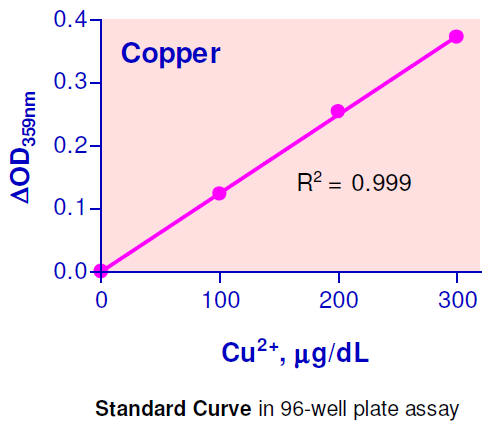
Sensitive and accurate. Linear detection range 7 μ g/dL
(1.0 μM)
to 300 μg/dL
(47 μM)
copper in 96-well plate assay.
Simple and high-throughput .
The simple procedure can be readily automated as a high-throughput assay
in 96-well plates for thousands of samples per day.
Improved reagent stability and versatility .
The optimized formulation has greatly enhanced reagent and signal
stability. Cuvet or 96-well plate assay.
APPLICATIONS
Direct Assays: biological, environmental, food and
beverage samples. Drug Discovery/Pharmacology: effects of drugs on Cu
metabolism.
KIT CONTENTS (250 tests in 96-well plates)
Reagent A: 10 mL Reagent B: 1.5 mL Reagent C: 40 mL
Copper Standard: 1 mL 1.5 mg/dL Cu2+
Storage conditions .
The kit is shipped at room temperature. Store all reagents at 4
°C. Shelf life of six months (see expiry dates on labels).
Precautions :
reagents are for research use only. Normal precautions for laboratory
reagents should be exercised while using the reagents. Please refer to
Material Safety Data Sheet for detailed information.
PROCEDURES
Note: metal chelators (e.g. EDTA) interfere with this
assay and should be avoided in sample preparation.
Procedure using 96-well plate:
1. Standards: transfer 100 μ L
dH2O into one Eppendorf tube labeled “Blank”. Into another tube labeled
“Standard”, mix 20
μL
1.5 mg/dL Standard and 80 μL dH2O (final 300
μg/dL
Cu2+).
Samples: transfer 100
μL
samples into separate tubes. Add 35 μL
Reagent A (trichloroacetic acid) to each tube and mix by vortexing. If
samples contain protein (e.g. serum/plasma), precipitates
form. Centrifuge tubes for 2 min at 14,000 rpm and
use clear supernatant for assay. For samples that do not contain
protein, the mixture remains clear and centrifugation is not necessary.
Transfer 100
μL
Blank, Standard and Sample into separate wells of a clear flat-bottom
96-well plate.
2. For each assay
well, prepare Working Reagent by mixing 5 μL
Reagent B and 150 μL Reagent C. Transfer 150
μL Working
Reagent to each well and tap plate to mix thoroughly.
3. Incubate 5 min at room temperature and read
optical density at 356- 362nm (peak absorbance at 359nm).
Note: if sample OD values are higher than the OD
value for the 300μ g/dL
Standard, dilute sample in dH2O and repeat assay. Multiply the results
by the dilution factor.
Procedure using cuvette:
Prepare standards and samples as for 96-well assay
procedure.
1. Transfer 400 μ L
Standards and Samples into separate cuvets.
2. Add 600
μL
Working Reagent. Mix by pipetting.
3. Incubate 5 min at room temperature and read optical
density at 356-362nm (peak absorbance at 359nm).
CALCULATION
The copper concentration of Sample is calculated as

ODSAMPLE, ODBLANK and ODSTANDARD
are optical density values of the Sample, Blank and the 300 μg/dL
Standard, respectively.
Conversions: 100 μg/dL Cu equals 15.5 μM, 0.0001%
or 1 ppm.
MATERIALS REQUIRED, BUT NOT PROVIDED
Pipeting devices and accessories. For 96-well plate
assays: clear flat-bottom 96-well plates and plate reader. For cuvet
assays: spectrophotometer and cuvets for measuring OD at 356-362nm.
GENERAL CONDSIDERATIONS
For scarce samples (e.g. mice serum or plasma), mix
sample with dH2O to a total of 100 μL, e.g. 50 μL serum + 50 μL dH2O.
Multiply the results by the dilution factor (2 fold).
EXAMPLES
Human serum, rat plasma, rat serum, and bovine serum
were assayed in duplicate using the 96-well plate assay protocol. The
copper concentrations were 97 ± 1, 104 ± 1, 101 ± 2, 78 ± 1 μg/dL,
respectively.
LITERATURE
1. Stuerenburg HJ, Eggers C (2000). Early detection of
noncompliance in Wilson's disease by consecutive copper determination in
cerebrospinal fluid. J Neurol Neurosurg Psychiatry 69: 701-702.
2. Liska SK, Kerkay J, Pearson KH (1985). Determination
of zinc and copper in urine using Zeeman effect flame atomic absorption
spectroscopy. Clin Chim Acta. 151:231-236.
3. Tessman RK, Lakritz J, Tyler JW, Casteel SW, Williams
JE, Dew RK. (2001). Sensitivity and specificity of serum copper
determination for detection of copper deficiency in feeder calves. J Am
Vet Med Assoc. 218:756-760. |
|




















 日本
日本