|
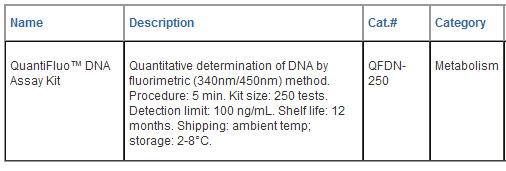
QuantiFluoTM DNA Assay Kit (QFDN-250)
Fluorimetric Quantitation of Nanogram
DNA
DESCRIPTION
DNA
quantitation is a common practice in molecular biology.
Very often DNA is available in minute quantities and the
traditional UV 260 nm absorbance method requires
microgram quantities for reliable results. Accurate
determination of DNA concentration, especially when DNA
is present at low concentrations, is crucial for
reproducible results in sequencing, cloning,
transfection and DNA labeling. Simple, direct and
automation-ready procedures for measuring DNA
concentration are very desirable. BioAssay Systems'
QuantiFluoTM DNA assay kit is designed to accurately
measure nanogram quantities of plasmid DNA, cDNA, DNA
following polymerase chain reaction and DNA eluted from
gels. The improved method utilizes Hoechst dye that
binds specifically with double- tranded DNA. The
fluorescence intensity, measured at 450nm (lexc
= 350nm), is directly proportional to the DNA
concentration in the sample. The optimized formulation
substantially reduces interference by substances in the
raw samples.
KEY FEATURES
Sensitive and
accurate.
Linear detection range 2 ng to 40 ng (100 – 2,000 ng/mL)
calf thymus DNA in 96-well plate assay.
Simple and high-throughput.
The “mix-and-read” procedure involves addition of a
single working reagent and reading the fluorescence
intensity. Can be readily automated as a high-throughput
assay for thousands of samples per day.
Low interference.
RNA, salt (up to 3M NaCl), detergent (< 0.01% SDS) and
common DNA extraction buffer do not interfere in the
assay.
APPLICATIONS:
Direct Assays:
plasmid DNA, genomic DNA, cDNA, DNA following polymerase
chain reaction, and DNA extracted from gel and other
matrices.
KIT CONTENTS
(250 tests in 96-well plates)
Reagent: 50 mL
Standard: 1 mL 10 μg/mL
calf thymus DNA Storage conditions. The kit is shipped
at room temperature. Store the DNA standard at -20°C and
the Reagent at 2-8°C. Shelf life of at least 12 months
(see expiry dates on labels).
Precautions:
reagents are for research use only. Normal precautions
for laboratory reagents should be exercised while using
the reagents. Please refer to Material Safety Data Sheet
for detailed information.
PROCEDURES
Preparation: bring reagents to room temperature
before use. Procedure using 96-well plate:
1. Prepare
400 μL
2000 ng/mL Premix by mixing 80
μL
Standard and 320 μL
TE buffer (10mM Tris, 1mM EDTA, pH 7.4). Dilute
standards as follows. Transfer 20
μL
diluted standards and samples into wells of
a
black flat-bottom 96-well plate. Store standards at 4°C
for future use.

2. Add 200
μL
working reagent and tap lightly to mix.
3.
Incubate 1 min at room temperature and read fluorescence
emission at 440 - 460nm (peak 450nm, excitation at
340-370 nm).
Procedure using cuvette:
1. Transfer 100 μL
diluted standards and samples to cuvets.
2. Add 1000
μL
working reagent and tap lightly to mix.
3.
Incubate 1 min at room temperature and read fluorescence
intensity at 440 - 460nm (peak 450nm, excitation at
340-360 nm).
CALCULATION
Subtract
blank fluorescence value (water, #8) from the standard
values and plot DF
against standard DNA concentrations.
Determine the slope using linear regression fitting. The
DNA concentration of Sample is calculated as

FSAMPLE
and FBLANK are fluorescence values of the sample and
water or buffer in which the sample was diluted,
respectively. n
is the sample dilution factor.
MATERIALS REQUIRED, BUT NOT PROVIDED
Pipeting devices and accessories. 1 x TE buffer.
Procedure using 96-well plate:
Black 96-well plates (e.g. Corning) and fluorescence
plate reader. Procedure
using cuvette:
Fluorescence spectrophotometer and fluorometric cuvets.
GENERAL CONSIDERATIONS
(1) For samples with unknown DNA concentration, pipet 1
μL
sample and mix with 99
μL
TE buffer. Make further serial 10-fold dilutions. Assay
all diluted samples and choose dilutions at which the
fluorescence intensity values fall within the linear
calibration range to calculate sample DNA concentration.
(2). Calf thymus DNA serves as a standard for plant and
animal DNA, because the AT content is conserved among
most DNAs from these two species. For bacterial DNA, a
different standard should be used that best matches the
sample DNA content. (3). Fluorescence intensity is half
when binding to the same single-stranded DNA. Short
singlestranded DNA pieces do not fluoresce with this
dye.

LITERATURE
1. Bachoon DS, Otero E, Hodson RE
(2001). Effects of humic substances on fluorometric DNA
quantification and DNA hybridization. J Microbiol
Methods 47:73-82.
2. Teare JM et al. (1997). Measurement
of nucleic acid concentrations using the DyNA Quant and
the GeneQuant. Biotechniques 22:1170-4.
3. Bester MJ, Potgieter HC, Vermaak WJ
(1994). Cholate and pH reduce interference by sodium
dodecyl sulfate in the determination of DNA with Hoechst.
Anal Biochem. 223:299-305.
|





















 GENTAUR Germany
Marienbongard 20
GENTAUR Germany
Marienbongard 20
 GENTAUR Italy
 Česká republika
Praha
Česká republika
Praha Danmark
 Finland Helsset
 Ελλάς Αθήνα
 Ireland Dublin
 Luxembourg
 Magyarország
Budapest
Magyarország
Budapest Nederland
 Norge
Oslo
Norge
Oslo Österreich
 Sverige
Stockholm
Sverige
Stockholm Schweiz Züri
 Canada Montreal
 US New York
 日本
日本