|
EnzyChromTM Galactose Assay Kit
(EGAL-100)
Quantitative Colorimetric Galactose
Determination
DESCRIPTION
GALACTOSE
(C6H12O6) is a monosaccharide that is found in dairy
products, sugar beets, gums and mucilages. It is also
synthesized in mammals, where it forms part of
glycolipids and glycoproteins in several tissues. It
forms the disaccharide lactose when combined with
glucose. Simple, direct and high-throughput assays for
galactose determination find wide applications. BioAssay
Systems' assay uses specific enzymecoupled reactions to
form a colored product. The color intensity at 570nm or
fluorescence intensity at 530nm/585nm is directly
proportional to the galactose concentration in the
sample.
KEY FEATURES
Use as
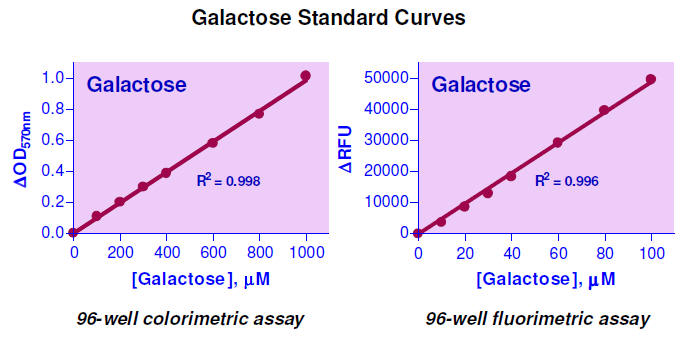
little as 20 μL samples. Linear detection range in
96-well plate: 10 to 1000 μM galactose for colorimetric
assays and 10 to 100 μM for fluorimetric assays.
APPLICATIONS:
Direct
Assays: galactose in serum, plasma, urine, saliva, milk,
culture medium and other biological samples. Drug
Discovery/Pharmacology: effects of drugs on galactose
metabolism. Food and Beverages: galactose in food and
beverages products. KIT CONTENTS: Assay Buffer: 10 mL
Enzyme Mix: 120 μL Dye Reagent: 120 μL Standard: 1 mL 10
mM Galactose Storage conditions. The kit is shipped on
dry ice. Store all components at -20°C. Shelf life of
three months after receipt. Precautions: reagents are
for research use only. Normal precautions for laboratory
reagents should be exercised while using the reagents.
Please refer to Material Safety Data Sheet for detailed
information.
COLORIEMTRIC PROCEDURE
Note:
(1) glycerol and SH-containing reagents (e.g. b–mercaptoethanol,
dithiothreitol) are known to interfere in this assay and
should be avoided in sample preparation.
(2) This
assay is based on a kinetic reaction. To ensure
identical incubation time, addition of Working Reagent
to standard and samples should be quick and mixing
should be brief but thorough. Use of a multi-channel
pipettor is recommended.
Sample
treatment: serum and plasma samples can be assayed
directly. Milk samples should be cleared by mixing 600
μL milk with 100 μL 6 N HCl. Centrifuge 5 min at 14,000
rpm.
Transfer
300 μL supernatant into a clean tube and neutralize with
50 μL 6 N NaOH. The neutralized supernatant is ready for
assay (dilution factor n = 1.36).
1.
Equilibrate all components to room temperature. During
experiment, keep thawed Enzyme Mix in a refrigerator or
on ice.
2.
Standards and samples: prepare 400 μL 1000 μM Standard
by mixing 40 μL 10 mM standard with 360 μL dH2O. Dilute
standard in dH2O as follows.
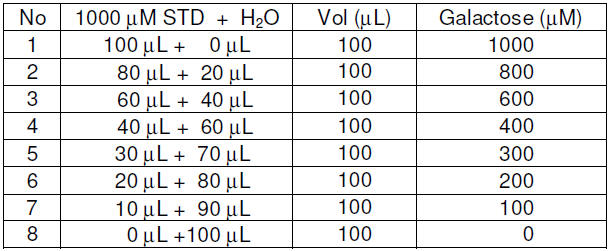
Transfer 20 μL standards and 20 μL
samples into separate wells of a clear flat-bottom
96-well plate.
3. Reaction. For each reaction
well, mix 85 μL Assay Buffer, 1 μL Enzyme Mix (vortex
briefly before pipetting), and 1 μL Dye Reagent in a
clean tube. Transfer 80 μL Working Reagent into each
reaction well. Tap plate to mix. Incubate 20 min at room
temperature.
4. Read optical density at 570nm
(550-585nm).
FLUORIMETRIC PROCEDURE
For fluorimetric assays, the linear
detection range is 10 to 100 μM galactose. Prepare 100
μM galactose standard by mixing 10 μL 10 mM standard
with 990 μL H2O. Then dilute standards in H2O (see
Colorimetric Procedure) to 100, 80, 60, 40, 30, 20,
10 and 0 μM. 1. Transfer 20 μL standards and 20 μL
samples into separate wells of a black 96-well
plate.
2. Add 80 μL Working Reagent, tap
plate to mix. Incubate 20 min.
3. Read fluorescence at lex = 530nm
and lem = 585nm.
Notes:
If the calculated galactose concentration of a sample is
higher than 1000 μM in colorimetric assay or 100 μM in
fluorimetric assay, dilute sample in water and repeat
the assay. Multiply result by the dilution factor n.
CALCULATION
Subtract blank value (water, #8) from
the standard values and plot the DOD or DRFU against
standard concentrations. Determine the slope and
calculate the galactose concentration of Sample,
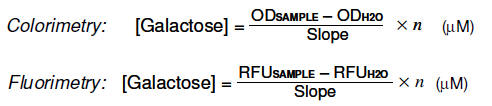
ODSAMPLE, ODH2O are
optical density values of the sample and water. RFUSAMPLE,
RFUH2O are fluorescence intensity values of the
sample and water. n is the dilution factor.
Conversions: 1 mM galactose
equals 18 mg/dL, 0.018% or 180 ppm.
MATERIALS REQUIRED, BUT NOT PROVIDED
Pipetting devices, centrifuge tubes,
clear flat-bottom 96-well plates, optical density plate
reader; black 96-well plates and fluorescence plate
reader.
LITERATURE
1. Novelli G, Reichardt JK. (2000).
Molecular basis of disorders of human galactose
metabolism: past, present, and future. Mol Genet Metab.
71:62-65.
2. Pudek MR et al. (1990). Low
concentration galactose determination in plasma adapted
to the Cobas-Bio. Clin Biochem. 23:221-223.
3. Gabrielli M. (1978). Serum
galactose determination with centrifugal analyzers.
Clin. Chem. 24:1990-1995 |





















 GENTAUR Germany
Marienbongard 20
GENTAUR Germany
Marienbongard 20
 GENTAUR Italy
 Česká republika
Praha
Česká republika
Praha Danmark
 Finland Helsset
 Ελλάς Αθήνα
 Ireland Dublin
 Luxembourg
 Magyarország
Budapest
Magyarország
Budapest Nederland
 Norge
Oslo
Norge
Oslo Österreich
 Sverige
Stockholm
Sverige
Stockholm Schweiz Züri
 Canada Montreal
 US New York
 日本
日本