|
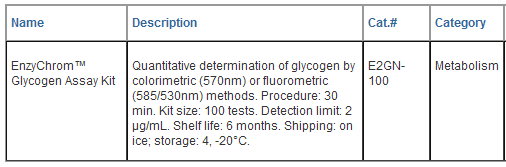
EnzyChromTM Glycogen Assay Kit (Cat#
E2GN-100)
Quantitative Colorimetric/Fluorimetric
Glycogen Determination
DESCRIPTION
GLYCOGEN is a branched polysaccharide of glucose
units linked by α- 1,4 glycosidic bonds and α-1,6
glycosidic bonds. It is stored primarily in the liver
and muscle, and forms an energy reserve that can be
quickly mobilized to meet a sudden need for glucose. The
most common glycogen metabolism disorder is found in
diabetes, in which, due to abnormal amounts of insulin,
liver glycogen can be abnormally accumulated or
depleted. Genetic glycogen storage diseases have been
associated with various inborn errors of metabolism
caused by deficiencies of enzymes necessary for glycogen
synthesis or breakdown. Simple, direct and
automation-ready procedures for measuring glycogen
concentrations find wide applications in research and
drug discovery. BioAssay Systems' glycogen assay uses a
single Working Reagent that combines the enzymatic break
down of glycogen and the detection of glucose in one
step. The color intensity of the reaction product at
570nm or fluorescence intensity at lem/ex = 585/530nm is
directly proportional to the glycogen concentration in
the sample. This simple convenient assay is carried out
at room temperature and takes only 30 min.
KEY FEATURES
Use as
little as 10 μL samples. Linear detection range: 2 to
200 μg/mL glycogen for colorimetric assays and 0.2 to 20
μg/mL for fluorimetric assays.
KIT
CONTENTS
Assay
Buffer:
12 mL
Enzyme A: 120 μL Enzyme B: 120 μL
Dye
Reagent: 120 μL Standard: 50 μL 50 mg/mL
Storage
conditions. The kit is shipped on ice. Store all
reagents at -20°C. Shelf life of six months after
receipt.
Precautions: Reagents are for research use only.
Normal precautions for laboratory reagents should be
exercised while using the reagents. Please refer to
Material Safety Data Sheet for detailed information.
SAMPLE PREPARATION
Samples
can be prepared according to established methods [1-3].
COLORIMETRIC PROCEDURE
1.
Equilibrate all components to room temperature. During
experiment, keep thawed enzymes in a refrigerator or on
ice.
2.
Standards and samples: Dilute standard by mixing 5
μL Standard with 1.25 mL dH2O to give 200 μg/mL
standard. Dilute standard in dH2O as follows.

Transfer 10 μL standard and samples
into separate wells of a clear flat-bottom microplate.
3. Working Reagent. For each
reaction well, mix 90 μL Assay Buffer, 1 μL Enzyme A, 1
μL Enzyme B and 1 μL Dye Reagent in a clean tube.
Transfer 90 μL Working Reagent into each reaction well.
Tap plate to mix.
4. Incubate 30 min at room
temperature. Read optical density at 570nm (550-585nm).
FLUORIMETRIC PROCEDURE
For fluorimetric assays, the linear
detection range is 0.2 to 20 μg/mL glycogen. Follow
steps 1-3 of the colorimetric procedure, but prepare 0,
5, 10, 15 and 20 μg/mL Standard and use a black
flat-bottom microplate. Incubate 30 min at room
temperature and read fluorescence at lex = 530nm and lem
= 585nm.
CALCULATION
Subtract Blank reading (OD570nm or
fluorescence intensity) from the standard reading values
and plot the DOD or DF against standard concentrations.
Determine the slope and calculate the glycogen
concentration of the sample.

RSAMPLE
and RBLANK are the OD570nm or fluorescence intensity
values
of the
sample and blank (water, or sample blank, see below).
GENERAL CONSIDERATIONS
1. If the
sample contains glucose, a Sample Blank well should be
added: Prepare Sample Blank reagent by mixing 90 μL
Assay Buffer, 1 μL Enzyme B, and 1 μL Dye Reagent (No
Enzyme A). Add this reagent only to the Sample Blank
wells. Subtract the OD or fluorescence of the Sample
Blank from the sample readings to calculate glycogen
concentration.
2. This
assay is based on a kinetic reaction, the use of a
multichannel pipettor for adding the working reagent is
recommended.
3.
Interference. SH-group containing reagents (e.g., DTT,
β- mercaptoethanol) may interfere with this assay and
should be avoided in sample preparation.
MATERIALS REQUIRED, BUT NOT PROVIDED
Pipeting
devices, centrifuge tubes, clear flat bottom 96-well
plates and plate reader.

LITERATURE
1. Murat
JC, Serfaty A. (1974). Simple enzymatic determination of
polysaccharide (glycogen) content of animal tissues.
Clin Chem. 20(12):1576-1577.
2. Bueding,
E. and Orrell, S.A. (1964). A Mild Procedure for the
Isolation of Polydisperse Glycogen from Animal Tissues.
J. Biol. Chem. 239: 4018-4020.
3.
Dalrymple, R. H. and Hamm, R. (1973) A method for the
extraction of glycogen and metabolites from a single
muscle sample. Intl. J. Food Sci & Tech 8(4): 439-444.
|





















 GENTAUR Germany
Marienbongard 20
GENTAUR Germany
Marienbongard 20
 GENTAUR Italy
 Česká republika
Praha
Česká republika
Praha Danmark
 Finland Helsset
 Ελλάς Αθήνα
 Ireland Dublin
 Luxembourg
 Magyarország
Budapest
Magyarország
Budapest Nederland
 Norge
Oslo
Norge
Oslo Österreich
 Sverige
Stockholm
Sverige
Stockholm Schweiz Züri
 Canada Montreal
 US New York
 日本
日本