Monoamine oxidase (MAO) is a flavin-containing enzyme that
catalyses the oxidation of a variety of amine-containing
neurotransmitters such as serotonin, norepinephrine,
epinephrine and dopamine to yield the corresponding
aldehydes (1). MAO exists in two isoforms, namely MAO-A and
MAO-B, which are the products of two distinct genes (2).
MAO-A and B exhibit different specificities to substrates
and inhibitor selectivities. Extensive studies have been
preformed to characterize their properties (3-7). MAO-A acts
preferentially on serotonin and norepinephrine, and is
inhibited by clorgyline. MAO-B acts preferentially on
2-phenylethylamine and benzylamine and is inhibited by
deprenyl and pargyline.
Localized in the outer mitochondrial membrane, these
enzymes are found throughout the body. Often only one form
of the enzyme is present in a specific organ and/or within a
specific cell type (8-9). In addition to their role in
regulating neurotransmitters, these enzymes are also
involved in processing biogenic amines (10) including
tyramine (11).
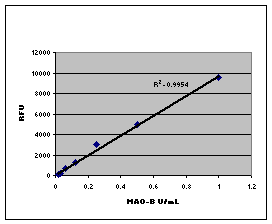
The Fluoro MAO-A/B detection kit utilizes a non -
fluorescent substrate, 10-Acetyl-3, 7-dihydroxyphenoxazine (ADHP)
to detect H202 released from the
conversion of a substrate to its aldehyde via MAO-A/B.
Furthermore, H202 oxidizes ADHP in a
1:1 stoichiometry to produce a fluorescent product resorufin.
This oxidation is catalyzed by Peroxidase. |





















 GENTAUR Germany
Marienbongard 20
GENTAUR Germany
Marienbongard 20
 GENTAUR Italy
 Česká republika
Praha
Česká republika
Praha Danmark
 Finland Helsset
 Ελλάς Αθήνα
 Ireland Dublin
 Luxembourg
 Magyarország
Budapest
Magyarország
Budapest Nederland
 Norge
Oslo
Norge
Oslo Österreich
 Sverige
Stockholm
Sverige
Stockholm Schweiz Züri
 Canada Montreal
 US New York
 日本
日本