:
20 mL Enzyme: 120 μL
Ketogutarate:
120 μL Standard: 400 μL 20 mM NH4Cl
NADH Reagent:
1 mL
Storage conditions.
The kit is shipped chilled. Store all components at -20°C. Shelf life of
at least 3 months.
Precautions:
reagents are for research use only. Normal precautions for laboratory
reagents should be exercised while using the reagents. Please refer to
Material Safety Data Sheet for detailed information.
PROCEDURES
Sample preparation:
solid samples can be extracted by homogenization in distilled water
(dH2O) and filtered, centrifuged or, if necessary,deproteinized to
remove any undissolved material. Samples should be clean and colorless
with pH adjusted to 7 - 8.Serum and plasma samples can be assayed
directly. Cell culture mediashould be diluted 5-10 fold in dH2O prior to
assay.
Colorimetric Procedure
1. Standards and Samples.
Equilibrate all components to room temperature. Briefly centrifuge tubes
before opening. Prepare a 1000 μM NH3 Standard Premix by mixing 15 μL of
the 20 mM Standard and 285μL dH2O. Dilute Standard as follows.
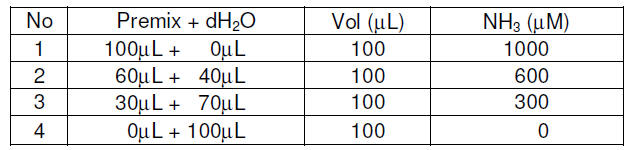
Transfer 20 μL standards into
separate wells of a clear, flat-bottom 96-well plate.
Transfer 20 μL of each sample
into two separate wells, one serving as a sample blank well (RBLANK) and
one as a sample well (RSAMPLE).
2. Enzyme Reaction. For
each standard and sample well, prepare Working Reagent by mixing 180 μL
Assay Buffer, 1 μL Enzyme, 8 μL
NADH Reagent and 1 μL
Ketoglutarate. Add 180 μL Working Reagent to the four Standards
and the Sample Wells. Prepare blank control reagent by mixing 180
μL Assay Buffer, 8 μLNADH Reagent and 1 μL Ketoglutarate (No Enzyme).
Add 180 μL Blank control reagent only to the Sample Blank Wells.
Tap plate to mix. Incubate 30 min at room temperature.
3. Read OD340nm.
Fluorimetric Procedure
The fluorimetric procedure is
the same as for the colorimetric assay, except that a black, flat-bottom
96-well plate is used. After incubation for 30 min at room temperature,
read fluorescence intensity at lex = 350-360 nm and lem = 450 nm.
CALCULATION
Subtract the standard values
from the blank value (#4) and plot the DOD or DF against standard
concentrations. Determine the slope and calculate the NH3 concentration
of Sample,

RSAMPLE and RBLANK are optical
density or fluorescence intensity readings of the Sample and Sample
Blank, respectively. n is the sample dilution factor.
Note:
if the calculated NH3 concentration is higher than 1000 μM, dilute
sample in dH2O and repeat assay. Multiply result by the dilution factor
n.
Conversions:
1000 μM NH3 equals 1.7 mg/dL or 17 ppm.
MATERIALS REQUIRED, BUT NOT
PROVIDED
Pipeting devices, and clear
flat-bottom 96-well plates and optical density plate reader for
colorimetric assays; black flat-bottom 96-well plate and fluorescence
intensity plate reader for fluorimetric assays.
1. Bruce, A.W. et al. (1978).
Two-point determination of plasma ammonia with the centrifugal analyzer.
Clin Chem. 24:782-787.
2. Mondzac, A. et al. (1965).
An enzymatic determination of ammonia in biological fluids. J Lab Clin
Med. 66:526-531.
3. Seligson, D. and Hirahara,
K. (1957). The measurement of ammonia in whole blood, erythrocytes, and
plasma. J Lab Clin Med. 49:962-974.





















 GENTAUR Germany
Marienbongard 20
GENTAUR Germany
Marienbongard 20
 GENTAUR Italy
 Česká republika
Praha
Česká republika
Praha Danmark
 Finland Helsset
 Ελλάς Αθήνα
 Ireland Dublin
 Luxembourg
 Magyarország
Budapest
Magyarország
Budapest Nederland
 Norge
Oslo
Norge
Oslo Österreich
 Sverige
Stockholm
Sverige
Stockholm Schweiz Züri
 Canada Montreal
 US New York
 日本
日本

