DESCRIPTION
INORGANIC SULFATE is one of
the most abundant anions in mammalian plasma1.
Sulfate plays important physiological roles in
activating and detoxifying xenobiotics,
steroids, neurotransmitters, and bile acids.
Sulfate is needed for the biosynthesis of
glycosaminoglycans, cerebroside sulfate, and
heparin sulfate. Undersulfation of cartilage
proteoglycans has been associated with human
inherited osteochondrodysplasia disorders. In
mammals, sulfate homeostasis is regulated by the
kidney. The majority of filtered sulfate is
absorbed in the proximal tubules, and only 5–20%
of the filtered load is excreted into the urine2.
Simple, direct and
automation-ready procedures for quantitative
determination of inorganic sulfate find wide
applications in research and drug discovery.
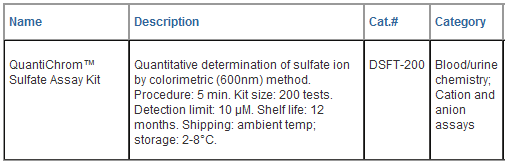
BioAssay Systems' sulfate assay kit is designed
to measure sulfate concentration in biological
fluids such as serum and urine. The improved
method utilizes the quantitative formation of
insoluble barium sulfate in polyethylene glycol3.
The turbidity which is measured as optical
density between 540 and 610nm (recommended
600nm), is an accurate measure of the sulfate
level in the sample.
.
Kits are shipped at room
temperature.
Storage Conditions. The
kit is shipped at room temperature. Store all
reagents at 4°C. Shelf life of at least 6 months
(see expiry dates on labels).
Precautions: reagents are
for research use only. Normal precautions for
laboratory reagents should be exercised while
using the reagents. Please refer to Material
Safety Data Sheet for detailed information.
PROCEDURES
Sample Treatment: Urine
samples should be diluted 20-fold in deionized
water prior to assay. Fresh serum or plasma
(non-hemolyzed) samples can be either assayed
immediately, or frozen for future tests. Samples
should be deproteinated as follows: mix 200 μL
sample and 100 μL Reagent B in a 1.5-mL
Eppendorf tube. Spin down protein precipitates 5
min at 14,000 rpm on a table centrifuge.
Transfer 200 μL supernatant for assay.
Reagent Preparation:
prepare at least 100 μL/well Working Reagent by
mixing 2000 μL Reagent A with 2 μL 60 mM sulfate
standard. This solution should be vortex (if
tube is used) or shaked (if bottle is used)
immediately to mix the reagents completely.
Prepare 1 mM working Sulfate Standard by mixing
20 μL 60 mM standard with 1180 μL deionized
water.
Procedure using 96-well
plate:
1. Transfer 200 μL deionzed
water (blank) and 200 μL 1 mM Sulfate Standard
into wells of a clear bottom 96-well plate.
Transfer 200 μL sample (serum/plasma
supernatant, or urine) in duplicate.
2. Add 100 μL Working Reagent
to each well. Tap plate to mix.
3. Incubate 5 min at room
temperature and read optical density at 540-
610nm (600nm).
Procedure using Cuvet:
1. Transfer 600 μL deionized
water, 600 μL 1 mM Sulfate Standard, 600 μL
sample (serum/plasma supernatant, or urine) into
1.5-mL centrifuge tubes.
2. Add 300 μL Working
Reagent. Mix quickly by inversion or vortexing.
Transfer contents to cuvets.
3. Incubate 5 min and read
OD600nm.
CALCULATION
The assay is linear up to 1.2
mM sulfate concentration. Sulfate concentration
(mM) in the sample can be calculated from the
single 1 mM standard as follows,
[Sulfate] = 1 x (ODSAMPLE –
ODBLANK)/(ODSTANDARD – ODBLANK) x n
“1” is the standard sulfate
concentration (1mM). n is the dilution
factor. n = 20 for urine samples and 1.5
for serum/plasma samples.
Conversions: 1 mM sulfate
equals 9.61 mg/dL or 96.1 ppm.
GENERAL CONSIDERATIONS
The following compounds do
not interfere: 400 mM sodium chloride, 500 mM
urea, 5 mM sodium phosphate, 4 mM sodium
citrate, 1.5 mM sodium EDTA. Ester sulfate can
be determined using the same method following a
digestion step3. This will allow
quantification of total sulfate (inorganic and
ester sulfate) in biological samples.
MATERIALS REQUIRED, BUT NOT
PROVIDED
Pipeting devices and
accessories, clear flat-bottom 96-well plates
and plate reader, or cuvets and spectrophotomer.
EXAMPLES:
Duplicate assays for rat
serum, fetal bovine serum, human serum, and
human urine gave sulfate content of 1.54 ± 0.07,
1.69 ± 0.09, 0.48 ± 0.01 and 10.5 ± 0.09 mM (n =
2).





















 GENTAUR Germany
Marienbongard 20
GENTAUR Germany
Marienbongard 20
 GENTAUR Italy
 Česká republika
Praha
Česká republika
Praha Danmark
 Finland Helsset
 Ελλάς Αθήνα
 Ireland Dublin
 Luxembourg
 Magyarország
Budapest
Magyarország
Budapest Nederland
 Norge
Oslo
Norge
Oslo Österreich
 Sverige
Stockholm
Sverige
Stockholm Schweiz Züri
 Canada Montreal
 US New York
 日本
日本