|
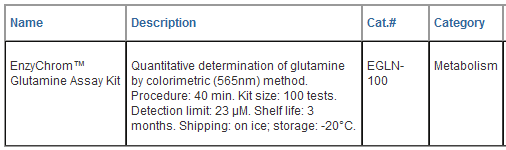
EnzyChromTM Glutamine Assay Kit
(EGLN-100)
Quantitative Colorimetric
Determination of Glutamine at 565 nm
DESCRIPTION
Glutamine
is an amino acid synthesized in the muscle that plays
major roles in protein synthesis, acid-base balance,
anabolic processes and is utilized for cellular energy
and as a carbon source. It is used in treatment of
injury, trauma, burns, and also as a supplement for
muscle growth and post-surgery healing. Simple, direct
and automation-ready procedures for measuring glutamine
concentration are very desirable. BioAssay Systems'
EnzyChromTM glutamine assay kit is based on hydrolysis
of glutamine to glutamate and colorimetric determination
of the product. The intensity of the product color,
measured at 565 nm, is proportional to the glutamine
concentration in the sample.
APPLICATIONS
Direct
Assays:
glutamine
in serum, plasma, urine, tissue extracts and cell
culture samples.
Drug
Discovery/Pharmacology: effects of drugs on
glutamine metabolism.
KEY
FEATURES
Sensitive
and accurate.
Use 20 μL sample. Linear detection range
0.023 - 2 mM glutamine in 96-well plate assay.
Convenient. The procedure
involves adding a single working reagent, incubation for
40 min at room temperature, adding a stop reagent and
reading the optical density. No 37°C heater is needed.
High-throughput. Can be
readily automated as a high-throughput 96- well plate
assay for thousands of samples per day.

Storage
conditions. Store all reagents at -20°C. Shelf life
of at least 3 months after receipt.
Precautions: reagents are for research use only.
Normal precautions for laboratory reagents should be
exercised while using the reagents. Please refer to
Material Safety Data Sheet for detailed information.
PROCEDURE
Note: (1).
this assay is based on an enzyme-catalyzed kinetic
reaction. Addition of Working Reagent should be quick
and mixing should be brief but thorough. Use of
multi-channel pipettor is recommended. (2). the
following substances interfere and should be avoided in
sample preparation: ascorbic acid, SDS (>0.2%), sodium
azide, NP-40 (>1%) and Tween-20 (>1%).
1.
Standard Curve. Prepare 2.0 mM glutamine Premix by
mixing 5 μL 100 mM Standard and 245 μL distilled water.
Dilute standard as
follows. Transfer 20
μL
standards into wells of a clear flat-bottom
96-well plate.

Samples: add 20 μL sample per well in separate
wells.
IMPORTANT:
if a
sample is known to contain glutamate, a sample blank
control is required. In this case, transfer an
additional 20
μL
sample into a separate well.
2.
Reaction. Spin the enzyme and reagent tubes briefly
before pipetting. Fresh reconstitution is recommended.
For each standard and sample well, prepare Working
Reagent by mixing 65 μL Assay Buffer, 1 μL Enzyme A, 1
μL Enzyme B, 2.5 μL NAD and 14 μL MTT.
Where a
sample blank is required, prepare a Blank Working
Reagent by mixing 65 μL
Assay Buffer, 1
μL
Enzyme B, 2.5
μL
NAD and 14
μL
MTT
(i.e. No
Enzyme A). Add 80 μL Working Reagent per well to
standards and sample
wells.
Where
appropriate, add 80 μL
Blank Working Reagent to the
Sample Blank wells.
Tap plate
to mix briefly and thoroughly.
3.
Incubate 40 min at room temperature. Add 100 μL Stop
Reagent to
each well. Read OD at 565 nm (520-600 nm).
CALCULATION
Subtract
water (#4) blank OD from OD values for the standards.
Plot DOD against standard concentrations. Determine the
slope and calculate sample glutamine concentration,

where ODSAMPLE and ODBLANK are the OD
values of the sample and water (if sample does not
contain glutamate) or sample blank (if sample contains
glutamate).
Note: if the calculated glutamine
concentration is higher than 2 mM, dilute sample in
distilled water and repeat the assay. Multiply the
results by the dilution factor n. Conversions: 1
mM glutamine = 14.6 mg/dL or 146 ppm.
MATERIALS REQUIRED, BUT NOT PROVIDED
Pipeting (multi-channel) devices.
Clear flat-bottom 96-well plates (e.g. Corning Costar)
and plate reader.

LITERATURE
1.
Cattaneo, MV and Luong, JH. (1993). Monitoring glutamine
in animal cell cultures using a chemiluminescence fiber
optic biosensor. Biotechnol Bioeng. 41(6):659-665.
2. Messer,
M. (1955). A simple method for the estimation of
glutamine in brain extracts. Biochim Biophys Acta.
17(1):151-152.
3. Foss,
OP. (1952). A new growth medium for the cultivation and
production of Clostridium welchii SR 12 in Krebs' method
for the quantitative determination of glutamine and
glutamic acid. Scand J Clin Lab Invest. 4(4):371-372.
|





















 GENTAUR Germany
Marienbongard 20
GENTAUR Germany
Marienbongard 20
 GENTAUR Italy
 Česká republika
Praha
Česká republika
Praha Danmark
 Finland Helsset
 Ελλάς Αθήνα
 Ireland Dublin
 Luxembourg
 Magyarország
Budapest
Magyarország
Budapest Nederland
 Norge
Oslo
Norge
Oslo Österreich
 Sverige
Stockholm
Sverige
Stockholm Schweiz Züri
 Canada Montreal
 US New York
 日本
日本