|


|
OUR SUPPLIERS
KOMABIOTECH
301,
Gayang Technotown, #1487
Gayang 3 dong,
Gangseo-gu
Seoul 157-793, KOREA
Spherotech, Inc.
27845 Irma Lee Circle, Unit 101
Lake Forest, IL 60045
|
|
Exalpha
Biologicals,
Inc.
2 Shaker Road,
Unit B101
Shirley, MA
01464
SCETI K.K
BIOSCIENCE Export DF Kasumigaseki Place,3-6-7 Kasumigaseki Chiyoda-ku, Tokyo 100-0013 JAPAN
|
EY
Laboratories, Inc. Headquarters
107 N.
Amphlett Blvd
San Mateo, CA. 94401 USA
EXBIO Praha, a.s.
Nad
Safinou II 366
252 42 Vestec
Czech Republic
Sacace Biotechnologies S.r.l.
Via Scalabrini,
44
22100 Como Italy
 GENTAUR BVBA
VAT BE0473327336
Av. de l Armee 68 B4
1040 Brussels
BELGIUM
Tel + 32 16 58 90
45
Fax + 32 16 50 90 45
 GENTAUR France SARL
SIRET 48423788800017
Rue Lagrange, 9
75005 Paris,
France
Tel 01 43 25 01 50
Fax 01 43 25 01 60
 GENTAUR Germany
Marienbongard 20
GENTAUR Germany
Marienbongard 20
52074 Aachen,
Germany
Tel 0241 56 00
99 68
Fax 0241 56 00 47 88
 GENTAUR
Pol Sp. Z.o.o. Ulica
Ogarna 15/19B m2 GENTAUR
Pol Sp. Z.o.o. Ulica
Ogarna 15/19B m2
80-826 GDANSK
Tel 00 48 58 760 77
08
Fax: 00 32 16 50 90
45
 GENTAUR Italy
23015 Milano, Italy
Tel 02 36 00 65
93
Fax 02 36 00 65
94
 Česká republika
Praha
Česká republika
Praha
+420246019719
 Danmark
+4569918806
 Finland Helsset
+358942419041
 Ελλάς Αθήνα
+302111768494
 Ireland Dublin
+35316526556
 Luxembourg
+35220880274
 Magyarország
Budapest
Magyarország
Budapest
+3619980547
 Nederland
+31208080893
 Norge
Oslo Norge
Oslo
+4721031366
 Österreich
+43720880899
 Sverige
Stockholm Sverige
Stockholm
+46852503438
 Schweiz Züri
+41435006251
Northern America
 Canada Montreal
+15149077481
 US New York
+17185132983
Other Countries
0032 (0)16 41 44 07 |
|
|
|
|
|
|

| |
|
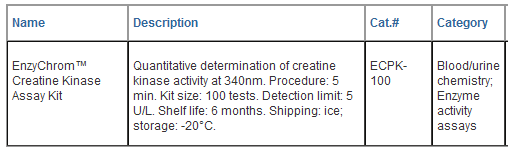
EnzyChromTM Creatine Kinase
Assay Kit (ECPK-100)
Colorimetric Determination of
Creatine Kinase Activity at 340 nm
DESCRIPTION
CREATINE KINASE
(CK), also known as creatine phosphokinase
(CPK), is an enzyme (EC 2.7.3.2) expressed
predominantly in skeletal muscle, smooth muscle
and the brain. The CK enzyme consists of two
subunits, which can be either B (brain type) or
M (muscle type), and hence three different
isoenzymes: CK-MM, CK-BB and CK-MB. CK catalyzes
the conversion of creatine to phosphocreatine,
consuming adenosine triphosphate (ATP) and
generating adenosine diphosphate (ADP) and the
reverse reaction. CK is often determined
routinely in emergency patients with chest pain
and acute renal failure. Elevation of CK is an
indication of damage to muscle and has been
associated with injury, rhabdomyolysis,
myocardial infarction, myositis, myocarditis,
malignant hyperthermia and neuroleptic malignant
syndrome, etc. Lower levels can be an indication
of alcoholic liver disease and rheumatoid
arthritis. Simple, direct and automation-ready
procedures for measuring CK activity are very
desirable. BioAssay Systems' QuantiChromTM
Creatine Kinase Assay Kit is based on enzyme
coupled reactions in which creatine phosphate
and ADP is converted to creatine and ATP by CK,
the generated ATP is used to phosphorylate
glucose by hexokinase to generate
glucose-6-phosphate, which is then oxidized by
NADP in the presence of glucose-6- phosphate
dehydrogenase.
The produced NADPH, measured at
340 nm, is proportionate to the CK activity in
the sample.
APPLICATIONS
Direct Assays: CK in serum,
plasma and other biological samples.
Pharmacology: effects of drugs
on CK activity.
KEY FEATURES
Sensitive and accurate .
Detection range: 5 to 300 U/L creatine kinase in
96-well plate assay.
Convenient .
The procedure involves adding a single working
reagent, and reading the optical density at 10
min and 40 min at room temperature or 37°C.
High-throughput .
Can be readily automated as a high-throughput
96- well plate assay for thousands of samples
per day.
KIT CONTENTS (100 tests
in 96-well plates)
Assay Buffer: 12 mL Substrate
Solution: 1.0 mL
Enzyme Mix: 120 μL Calibrator:
150 μ L
Storage conditions .
This kit is shipped on dry ice. Store all
reagents at -20°C. Shelf life of at least 6
months (see expiry dates on labels).
Precautions :
reagents are for research use only. Normal
precautions for laboratory reagents should be
exercised while using the reagents. Please refer
to Material Safety Data Sheet for detailed
information.
PROCEDURES
Sample Preparation .
Use non-hemolyzed samples. Samples should be
assayed within 4 hours of blood collection if
they remain at room temperature, or within 12
hours if stored at 4°C. Samples can be stored at
-80°C and should be thawed only once. If
turbidity is observed, centrifuge sample and use
clear supernatant for assay.
Reagent Reconstitution .
Bring all components to room temperature.
For each reaction well, mix 10
μL Substrate Solution, 100
μL
Assay Buffer and 1 μL
Enzyme Mix. Fresh reconstitution is recommended.
If the assay is to be carried out at 37°C, warm
up the Reconstituted Reagent at 37°C.
1.
Calibrator: transfer
110 μL water and (10 μL Calibrator + 100 μL
water) into separate wells of a clear bottom
96-well plate.
Samples: transfer 10 μL
samples into separate wells. Add 100 μ L
Reconstituted Reagent and tap plate to mix.
2. Reaction. Incubate
at room temperature or 37° C.
CK is fully
activated within 10 min by glutathione provided
in the Substrate
Solution. Read OD340nm at 10
min and again at 40 min.
3.
Calculation.
Calculate sample CK activity using the equation,

OD40min and OD10min are OD340nm
values at 40 min and 10 min for the sample.
ODCALIBRATOR and ODH2O are OD340nm values of the
Calibrator and water blank at 40 min. The value
100 is the equivalent activity (U/L) of the
Calibrator under the assay conditions. Unit
definition: one unit of CK will transfer 1 μ mole
of phosphate from phosphocreatine to ADP per min
at pH 6.0.
Note:
If the CK activity is expected to be higher than
300 U/L, read OD340nm at 10 min and again at 15
min. To calculate the CK activity replace
(OD40min – OD10min) with (OD15min – OD10min) and
replace the factor 100 with 600 in the above
equation. Linear range: 30 to 1,800 U/L CK
activity.
MATERIALS REQUIRED, BUT NOT
PROVIDED
Pipeting (multi-channel)
devices. Clear-bottom 96-well plates (e.g.
Corning Costar) and plate reader.
GENERAL CONSIDERATIONS
This assay is based on an
enzyme-catalyzed kinetic reaction. Addition of
Reconstituted Reagent should be quick and mixing
should be brief but thorough. Use of
multi-channel pipettor is recommended.
EXAMPLES
Samples were assayed in
duplicate using the 96-well protocol. The CK
activity (U/L) was 12.0 ± 0.9 for a rat serum
sample, 11.0 ± 0.5 for human serum, 28 ± 1 for
human plasma, 9.0 ± 0.8 for mouse serum and 49 ±
2 for bovine serum.

PUBLICATIONS
1. Itaka K et al (2010).
Polyplex nanomicelle promotes hydrodynamic gene
introduction to skeletal muscle. J Control
Release. 143(1):112-9.
2. Steen C et al (2010). Reduced
Creatine Kinase B Activity in Multiple Sclerosis
Normal Appearing White Matter. PLoS One
5(5):e10811.
3. Kwon S et al. (2010). ASB9
interacts with ubiquitous mitochondrial creatine
kinase and inhibits mitochondrial function. BMC
Biol. 8:23. |
|
|
|
|




















 日本
日本