|


|
OUR SUPPLIERS
KOMABIOTECH
301,
Gayang Technotown, #1487
Gayang 3 dong,
Gangseo-gu
Seoul 157-793, KOREA
Spherotech, Inc.
27845 Irma Lee Circle, Unit 101
Lake Forest, IL 60045
|
|
Exalpha
Biologicals,
Inc.
2 Shaker Road,
Unit B101
Shirley, MA
01464
SCETI K.K
BIOSCIENCE Export DF Kasumigaseki Place,3-6-7 Kasumigaseki Chiyoda-ku, Tokyo 100-0013 JAPAN
|
EY
Laboratories, Inc. Headquarters
107 N.
Amphlett Blvd
San Mateo, CA. 94401 USA
EXBIO Praha, a.s.
Nad
Safinou II 366
252 42 Vestec
Czech Republic
Sacace Biotechnologies S.r.l.
Via Scalabrini,
44
22100 Como Italy
 GENTAUR BVBA
VAT BE0473327336
Av. de l Armee 68 B4
1040 Brussels
BELGIUM
Tel + 32 16 58 90
45
Fax + 32 16 50 90 45
 GENTAUR France SARL
SIRET 48423788800017
Rue Lagrange, 9
75005 Paris,
France
Tel 01 43 25 01 50
Fax 01 43 25 01 60
 GENTAUR Germany
Marienbongard 20
GENTAUR Germany
Marienbongard 20
52074 Aachen,
Germany
Tel 0241 56 00
99 68
Fax 0241 56 00 47 88
 GENTAUR
Pol Sp. Z.o.o. Ulica
Ogarna 15/19B m2 GENTAUR
Pol Sp. Z.o.o. Ulica
Ogarna 15/19B m2
80-826 GDANSK
Tel 00 48 58 760 77
08
Fax: 00 32 16 50 90
45
 GENTAUR Italy
23015 Milano, Italy
Tel 02 36 00 65
93
Fax 02 36 00 65
94
 Česká republika
Praha
Česká republika
Praha
+420246019719
 Danmark
+4569918806
 Finland Helsset
+358942419041
 Ελλάς Αθήνα
+302111768494
 Ireland Dublin
+35316526556
 Luxembourg
+35220880274
 Magyarország
Budapest
Magyarország
Budapest
+3619980547
 Nederland
+31208080893
 Norge
Oslo Norge
Oslo
+4721031366
 Österreich
+43720880899
 Sverige
Stockholm Sverige
Stockholm
+46852503438
 Schweiz Züri
+41435006251
Northern America
 Canada Montreal
+15149077481
 US New York
+17185132983
Other Countries
0032 (0)16 41 44 07 |
|
|
|
|
|
|

| |
|
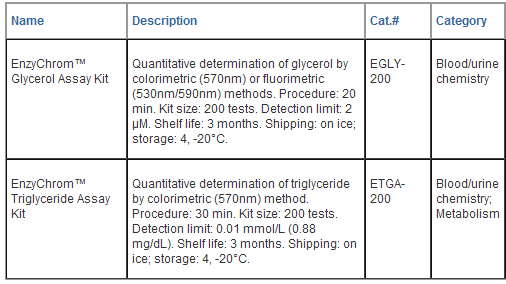
EnzyChromTM Glycerol Assay Kit (Cat#
EGLY-200)
Quantitative Colorimetric/Fluorimetric
Glycerol Determination
DESCRIPTION
GLYCEROL [GLYCERIN or
GLYCERINE, C3H5(OH)3] is widely used in foods,
beverages and pharmaceutical formulations. It is also a
main byproduct of biodiesel production. Simple, direct
and automation-ready procedures for measuring glycerol
concentrations find wide applications. BioAssay Systems'
glycerol assay uses a single Working Reagent that
combines glycerol kinase, glycerol phosphate oxidase and
color reactions in one step. The color intensity of the
reaction product at 570nm or fluorescence intensity at
lem/ex = 585/530nm is directly proportional to glycerol
concentration in the sample.
KEY FEATURES
Sensitive and accurate .
Use as little as 10 μL samples. Linear detection range
in 96-well plate: 10 to 1000 μM (92 μg/dL to 9.2 mg/dL)
glycerol for colorimetric assays and 2 to 50 μM for
fluorimetric assays.
Simple and convenient. The
procedure involves addition of a single working reagent
and incubation for 20 min at room temperature,
compatible for HTS assays.
Improved reagent stability. The
optimized formulation has greatly enhanced the reagent
and signal stability.
APPLICATIONS:
Direct Assays:
glycerol in
biological samples (e.g. serum and plasma).
Drug Discovery/Pharmacology:
effects of drugs on glycerol metabolism.
Food and Beverages: glycerol in
food, beverages, pharmaceutical formulations etc.
KIT CONTENTS
Assay Buffer:
24 mL
Enzyme Mix: 500 μL ATP: 250 μL
Dye Reagent: 220 μL Standard:
100 μL 100 mM Glycerol
Storage conditions. The kit is
shipped on dry ice. Store Assay Buffer at 4°C and other
reagents at -20°C. Shelf life of three months after
receipt.
Precautions: reagents are for
research use only. Normal precautions for laboratory
reagents should be exercised while using the reagents.
Please refer to Material Safety Data Sheet for detailed
information.
COLORIEMTRIC PROCEDURE
Note: SH-group containing
reagents (e.g. mercaptoethanol, DTT) may interfere with
this assay and should be avoided in sample preparation.
1. Equilibrate all components to room
temperature. Keep thawed Enzyme Mix in a refrigerator or
on ice. Dilute standard in distilled water as follows
(diluted standards can be used for future assays when
stored refrigerated).
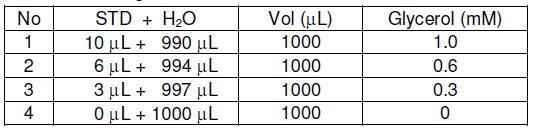
Transfer 10 μL standards and 10 μL
samples into separate wells of a clear 96-well plate.
2. For each reaction well, mix 100 μL
Assay Buffer, 2 μL Enzyme Mix, 1 μL ATP and 1 μL Dye
Reagent in a clean tube. This Working Reagent should be
used on the same day of preparation. Transfer 100 μL
Working Reagent into each reaction well. Tap plate to
mix.
3. Incubate 20 min at room
temperature. Read optical density at 570nm (550-585nm).
Note: if the Sample OD is higher
than the Standard OD at 1.0 mM, dilute sample in water
and repeat the assay. Multiply result by the dilution
factor.
CALCULATION
Subtract blank OD (water, #4) from the
standard OD values and plot the OD against standard
concentrations. Determine the slope using linear
regression fitting. The glycerol concentration of Sample
is calculated as

ODSAMPLE and ODH2O are
optical density values of the sample and water.
Conversions: 1mM glycerol equals 9.2 mg/dL, 92 ppm.
FLUORIMETRIC PROCEDURE
For fluorimetric assays, the linear
detection range is 2 to 50 μM glycerol. Mix 10 μL 100 mM
Standard with 990 μL H2O (final 1 mM).
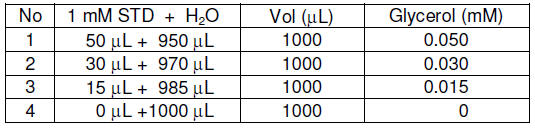
Dilute standards as above. Transfer 10
μL standards and 10 μL samples into separate wells of a
black 96-well plate. Add 100 μL Working Reagent
(see Colorimetric Procedure). Tap plate to mix.
Incubate 20 min at room temperature and read
fluorescence at lex = 530nm and lem = 585nm. The
glycerol concentration of Sample is calculated as

LITERATURE
1. Duncan RE, et al. (2007). Regulation
of lipolysis in adipocytes. Annu Rev Nutr. 27:79-101.
2. Moller F, Roomi MW. (1974). An
enzymatic, spectrophotometric glycerol assay with
increased basic sensitivity. Anal Biochem. 59(1):248-58.
3. MacRae AR. (1977). A semi-automated
enzymatic assay for free glycerol and triglycerides in
serum or plasma. Clin Biochem. 10(1):16-9 |
|
|
|
EnzyChromTM Triglyceride Assay
Kit (Cat# ETGA-200)
Quantitative Colorimetric
Triglyceride Determination at 570nm
DESCRIPTION
TRIGLYCERIDE, also known
as TRIACYLTRIGLYCERIDE or TRIACYLGLYCERIDE,
is
the main constituent in vegetable oil and animal
fats. Triglycerides play an important role as
energy sources and transporters of dietary fat.
In the human body, high levels of triglycerides
in the bloodstream have been linked to
atherosclerosis, heart disease and pancreatitis.
Simple, direct and automation-ready procedures
for measuring triglyceride concentrations find
wide applications in research and drug
discovery. BioAssay Systems' triglyceride assay
uses a single Working Reagent that combines
triglyceride hydrolysis and glycerol
determination in one step, in which a dye
reagent is oxidized to form a colored product.
The color intensity at 570nm is directly
proportional to triglyceride concentration in
the sample.
KEY FEATURES
Sensitive and accurate. Use
as little as 10 μL samples. Linear detection
range 0.01 mmol/L to 1.0 mmol/L (0.88 mg/dL to
88.5 mg/dL) triglyceride. Simple and convenient .
The procedure involves addition of a single
working reagent and incubation for 30 min at
room temperature, compatible for HTS assays.
Improved reagent
stability.
The optimized formulation has greatly enhanced
the reagent and signal stability.
APPLICATIONS:
Direct Assays:
triglyceride in biological samples (e.g. serum
and plasma).
Drug Discovery/Pharmacology:
effects of drugs on triglyceride metabolism.
KIT CONTENTS
Assay Buffer: 24 mL ATP: 250
μL Dye Reagent: 220 μL
Enzyme Mix: 500 μL Lipase:
1000 μL
Standard: 100 μL (equivalent
to 100 mmol/L Triglyceride)
Storage conditions .
The kit is shipped on dry ice. Store Assay
Buffer at 4°C
and other reagents at -20°C. Shelf life of three
months after receipt.
Precautions :
reagents are for research use only. Normal
precautions for laboratory reagents should be
exercised while using the reagents. Please refer
to Material Safety Data Sheet for detailed
information.
PROCEDURES
Note :
(1) SH-group containing reagents (e.g.
mercaptoethanol, DTT) may interfere with this
assay and should be avoided in sample
preparation; (2) if sample contains glycerol,
use BioAssay Systems' EnzyChromTM Glycerol Assay
Kit (Cat# EGLY-200) to determine glycerol
concentration and subtract the glycerol value to
yield triglyceride concentration.
1. Equilibrate all components
to room temperature. Keep thawed Lipase and
Enzyme Mix in a refrigerator or on ice. Dilute
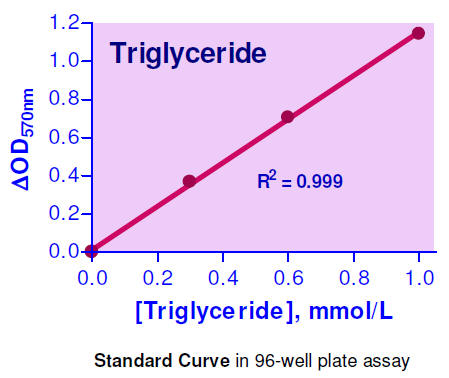
Standard in distilled water as follows. Transfer
10
μL
diluted standards into wells of a clear 96-well
plate. Diluted standards can be used for future
assays when stored refrigerated.

Serum and plasma samples
should be diluted 5-fold in dH2O and are assayed
directly. Cells and other solid samples can be
solubilized in 5% Triton X-100 (see Ref. 3).
Transfer 10 μL samples into separate
wells of the 96-well plate.
2.
Prepare Working Reagent for each well, by mixing
100
μL
Assay
Buffer, 2
μL
Enzyme Mix, 5
μL
Lipase, 1
μL
ATP and 1
μL
Dye
Reagent in a clean tube. Transfer 100
μL
Working Reagent into
standards and sample wells. Tap plate to mix.
3. Incubate 30 min at room
temperature. Read optical density at 570nm
(550-585nm).
Note :
1. if the Sample OD is higher than the Standard
OD at 1.0 mmole/L triglyceride, dilute sample in
water and repeat the assay. Multiply by the
dilution factor
n.
CALCULATION
Subtract ODH2O (water, #4)
from the standard OD values and plot the OD
against standard concentrations. Determine the
slope using linear regression fitting. The
triglyceride concentration of Sample is
calculated as

ODSAMPLE and ODH2O are
optical density values of the sample and the
water blank (# 4). n is the dilution
factor. For example serum or plasma samples are
diluted 5-fold prior to assay, n = 5.
Conversions: 1 mmol/L
triglyceride equals 88.5 mg/dL or 10 ppm.
MATERIALS REQUIRED, BUT NOT
PROVIDED
Pipeting devices, centrifuge
tubes, clear flat bottom 96-well plates (e.g.
Corning Costar) and plate reader.
LITERATURE
1. Nägele U et al (1984).
Reagent for the enzymatic determination of serum
total triglycerides with improved lipolytic
efficiency. J Clin Chem Clin Biochem.
22(2):165-74.
2. Bucolo, G. and David, H.
(1973). Quantitative determination of serum
triglycerides by the use of enzymes. Clin.
Chem.19(5): 476-482.
3. Zhu Y et al (2000). Genomic
interval engineering of mice identifies a novel
modulator of triglyceride production. PNAS
97(3): 1137-1142. |
|
|
|
|




















 日本
日本