|


|
OUR SUPPLIERS
KOMABIOTECH
301,
Gayang Technotown, #1487
Gayang 3 dong,
Gangseo-gu
Seoul 157-793, KOREA
Spherotech, Inc.
27845 Irma Lee Circle, Unit 101
Lake Forest, IL 60045
|
|
Exalpha
Biologicals,
Inc.
2 Shaker Road,
Unit B101
Shirley, MA
01464
SCETI K.K
BIOSCIENCE Export DF Kasumigaseki Place,3-6-7 Kasumigaseki Chiyoda-ku, Tokyo 100-0013 JAPAN
|
EY
Laboratories, Inc. Headquarters
107 N.
Amphlett Blvd
San Mateo, CA. 94401 USA
EXBIO Praha, a.s.
Nad
Safinou II 366
252 42 Vestec
Czech Republic
Sacace Biotechnologies S.r.l.
Via Scalabrini,
44
22100 Como Italy
 GENTAUR BVBA
VAT BE0473327336
Av. de l Armee 68 B4
1040 Brussels
BELGIUM
Tel + 32 16 58 90
45
Fax + 32 16 50 90 45
 GENTAUR France SARL
SIRET 48423788800017
Rue Lagrange, 9
75005 Paris,
France
Tel 01 43 25 01 50
Fax 01 43 25 01 60
 GENTAUR Germany
Marienbongard 20
GENTAUR Germany
Marienbongard 20
52074 Aachen,
Germany
Tel 0241 56 00
99 68
Fax 0241 56 00 47 88
 GENTAUR
Pol Sp. Z.o.o. Ulica
Ogarna 15/19B m2 GENTAUR
Pol Sp. Z.o.o. Ulica
Ogarna 15/19B m2
80-826 GDANSK
Tel 00 48 58 760 77
08
Fax: 00 32 16 50 90
45
 GENTAUR Italy
23015 Milano, Italy
Tel 02 36 00 65
93
Fax 02 36 00 65
94
 Česká republika
Praha
Česká republika
Praha
+420246019719
 Danmark
+4569918806
 Finland Helsset
+358942419041
 Ελλάς Αθήνα
+302111768494
 Ireland Dublin
+35316526556
 Luxembourg
+35220880274
 Magyarország
Budapest
Magyarország
Budapest
+3619980547
 Nederland
+31208080893
 Norge
Oslo Norge
Oslo
+4721031366
 Österreich
+43720880899
 Sverige
Stockholm Sverige
Stockholm
+46852503438
 Schweiz Züri
+41435006251
Northern America
 Canada Montreal
+15149077481
 US New York
+17185132983
Other Countries
0032 (0)16 41 44 07 |
|
|
|
|
|
|

| |
|
pNPP Phosphatase Assay Kits
Colorimetric Determination of
Phosphatase Activity at 405 nm
DESCRIPTION
Para-nitrophenyl
phosphate (pNPP) is a chromogenic substrate for
most phosphatases such as alkaline phosphatases,
acid phosphatases, protein tyrosine phosphatases
and serine/threonine phosphatases. The reaction
yields para-nitrophenol, which becomes an
intense yellow soluble product under alkaline
conditions and can be conveniently measured at
405 nm on a spectrophotometer.

This homogeneous
"mix-and-measure" assay involves simply adding a
single reagent to the phosphatase and measuring
the product formation on an absorbance reader.
The assay can be conveniently performed in
cuvettes, tubes or multi-well plates at either
room temperature or 37°C.
KEY FEATURES
High sensitivity and wide
linear range .
The detection limit is generally 3 ng
phosphatase or below.
Homogeneous and simple
procedure. No wash or reagent transfer steps
are involved. The assay can be completed within
30 minutes.
Robust and amenable to HTS.
All reagents are compatible with highthroughput
liquid handling instruments.
APPLICATIONS
Enzyme Activity Assay and
Quality Control
for
phosphatase production.
Characterization of Kinetics
of phosphatase reaction.
Drug Discovery:
high-throughput screen for phosphatase
inhibitors.
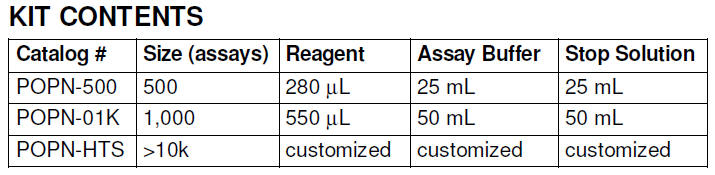
Storage conditions. The
kit is shipped at ambient temperature. Store
Reagent at -20°C and other components at 4°C.
Shelf life: 12 months.
Precautions: reagents are
for research use only. Normal precautions for
laboratory reagents should be exercised while
using the reagents. Please refer to Material
Safety Data Sheet for detailed information.
PROCEDURE USING 96-WELL PLATE
1. Equilibrate all reagents
to room temperature by allowing them to stand
for 30 minutes at room temperature. Prepare
enough pNPP Substrate by mixing per assay 0.5 μL
Reagent and 50 μL Assay Buffer.
2. Serially dilute enzyme in
a proper Enzyme Buffer. Prepare enough solution
for triplicate assays. Transfer 50 μL of each
enzyme dilution to wells of a clear, flat-bottom
96-well plate. In addition, prepare a blank
control that contains 50 μL Enzyme Buffer only.
Initiate the reaction by adding 50 μL pNPP
Substrate to each well.
3. Incubate for 10-30 minutes
at room temperature.
4. Stop the reaction by
adding 50 μL Stop Solution. Mix by quickly
tapping the plate. Alternatively, plates can be
shaken for 10 seconds on an orbital plate
shaker.
5. Read the absorbance of
each well at 405 nm.
PROCEDURE USING 384-WELL
PLATE
The 384-well assay procedure
is the same as for the 96-well plate protocol
except that 25 μL is mixed with 25 μL pNPP
Substrate. After the incubation, add 25 μL Stop
Solution.
GENERAL CONSIDERATIONS
(1). Fresh reconstitution of
the Reagent is recommended although the
reconstituted pNPP Substrate may be stable for
up to 4 weeks when stored at -20 °C.
(2). Assays can be performed
at room temperature or at 37 °C.
(3). The pH of the Assay
Buffer is 7.2 and is compatible with the
majority of neutral phosphatases such as protein
phosphatases. For an acid phosphatase, we
recommend using 100 mM sodium acetate (pH 5.5),
10 mM MgCl2 as Enzyme Buffer. For an alkaline
phosphatase, we recommend using our DALP-250
Assay Kit.
DATA ANALYSIS
Calculate the average and
standard derivations of the triplicate assays
and subtract the blank values. Enzyme activity
is calculated from Beer- Lambert law as follows,

where e is the molar
extinction coefficient (M-1 × cm-1). For p-nitrophenol,
e = 1.78 x 10⁴ M-1 × cm-1. OD405nm (cm-1) is the
absorbance at 405 nm divided by the light-path
length (cm). V is the final assay volume, i.e.,
150 μL for 96-well plate assay and 75 μL for
384-well plate assay.
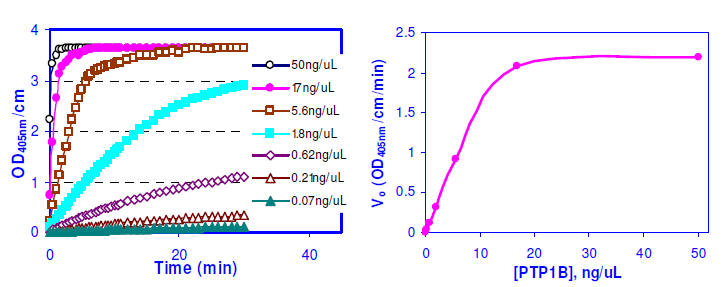
Left: PTP1B is one member
of the large protein tyrosine phosphatase
family. The pNPP assay was performed in a
384-well plate. After the reaction was initiated
by the addition of pNPP Substrate, the plate was
read on every 0.5 minutes for 30 minutes.
Right: a plot of the
initial rate (Vo) against enzyme concentration.
The detection limit was 3 ng PTP1B. The enzyme
activity measured from the linear range was 2.2
μmoles/min/μg. The turn-over number was 82,280
per minute.
PUBLICATIONS
1. Monick, M.M. et al (2006).
Active ERK contributes to protein translation by
preventing JNK-dependent inhibition of protein
phosphatase. J. Immunol. 177: 1636–1645.
2. Nakano, Y. (2007). Novel
function of DUSP14/MKP6 (dual specific
phosphatase 14) as a nonspecific regulatory
molecule for delayed-type hypersensitivity.
British J. Dermatology 156 (5): 848–860.
3. Lee, S.W. et al (2008).
The Xanthomonas oryzae pv. oryzae PhoPQ
two-component system is required for AvrXA21
activity, hrpG expression, and virulence.
J. Bacteriol.190(6):2183-97. |
|
pNPP Phosphatase Assay Kits
Colorimetric Determination of
Phosphatase Activity at 405 nm
DESCRIPTION
Para-nitrophenyl
phosphate (pNPP) is a chromogenic substrate for
most phosphatases such as alkaline phosphatases,
acid phosphatases, protein tyrosine phosphatases
and serine/threonine phosphatases. The reaction
yields para-nitrophenol, which becomes an
intense yellow soluble product under alkaline
conditions and can be conveniently measured at
405 nm on a spectrophotometer.
This homogeneous
"mix-and-measure" assay involves simply adding a
single reagent to the phosphatase and measuring
the product formation on an absorbance reader.
The assay can be conveniently performed in
cuvettes, tubes or multi-well plates at either
room temperature or 37°C.
KEY FEATURES
High sensitivity and wide
linear range .
The detection limit is generally 3 ng
phosphatase or below.
Homogeneous and simple
procedure. No wash or reagent transfer steps
are involved. The assay can be completed within
30 minutes.
Robust and amenable to HTS.
All reagents are compatible with highthroughput
liquid handling instruments.
APPLICATIONS
Enzyme Activity Assay and
Quality Control
for
phosphatase production.
Characterization of Kinetics
of phosphatase reaction.
Drug Discovery:
high-throughput screen for phosphatase
inhibitors.
Storage conditions. The
kit is shipped at ambient temperature. Store
Reagent at -20°C and other components at 4°C.
Shelf life: 12 months.
Precautions: reagents are
for research use only. Normal precautions for
laboratory reagents should be exercised while
using the reagents. Please refer to Material
Safety Data Sheet for detailed information.
PROCEDURE USING 96-WELL PLATE
1. Equilibrate all reagents
to room temperature by allowing them to stand
for 30 minutes at room temperature. Prepare
enough pNPP Substrate by mixing per assay 0.5 μL
Reagent and 50 μL Assay Buffer.
2. Serially dilute enzyme in
a proper Enzyme Buffer. Prepare enough solution
for triplicate assays. Transfer 50 μL of each
enzyme dilution to wells of a clear, flat-bottom
96-well plate. In addition, prepare a blank
control that contains 50 μL Enzyme Buffer only.
Initiate the reaction by adding 50 μL pNPP
Substrate to each well.
3. Incubate for 10-30 minutes
at room temperature.
4. Stop the reaction by
adding 50 μL Stop Solution. Mix by quickly
tapping the plate. Alternatively, plates can be
shaken for 10 seconds on an orbital plate
shaker.
5. Read the absorbance of
each well at 405 nm.
PROCEDURE USING 384-WELL
PLATE
The 384-well assay procedure
is the same as for the 96-well plate protocol
except that 25 μL is mixed with 25 μL pNPP
Substrate. After the incubation, add 25 μL Stop
Solution.
GENERAL CONSIDERATIONS
(1). Fresh reconstitution of
the Reagent is recommended although the
reconstituted pNPP Substrate may be stable for
up to 4 weeks when stored at -20 °C.
(2). Assays can be performed
at room temperature or at 37 °C.
(3). The pH of the Assay
Buffer is 7.2 and is compatible with the
majority of neutral phosphatases such as protein
phosphatases. For an acid phosphatase, we
recommend using 100 mM sodium acetate (pH 5.5),
10 mM MgCl2 as Enzyme Buffer. For an alkaline
phosphatase, we recommend using our DALP-250
Assay Kit.
DATA ANALYSIS
Calculate the average and
standard derivations of the triplicate assays
and subtract the blank values. Enzyme activity
is calculated from Beer- Lambert law as follows,
where e is the molar
extinction coefficient (M-1 × cm-1). For p-nitrophenol,
e = 1.78 x 10⁴ M-1 × cm-1. OD405nm (cm-1) is the
absorbance at 405 nm divided by the light-path
length (cm). V is the final assay volume, i.e.,
150 μL for 96-well plate assay and 75 μL for
384-well plate assay.
Left: PTP1B is one member
of the large protein tyrosine phosphatase
family. The pNPP assay was performed in a
384-well plate. After the reaction was initiated
by the addition of pNPP Substrate, the plate was
read on every 0.5 minutes for 30 minutes.
Right: a plot of the
initial rate (Vo) against enzyme concentration.
The detection limit was 3 ng PTP1B. The enzyme
activity measured from the linear range was 2.2
μmoles/min/μg. The turn-over number was 82,280
per minute.
PUBLICATIONS
1. Monick, M.M. et al (2006).
Active ERK contributes to protein translation by
preventing JNK-dependent inhibition of protein
phosphatase. J. Immunol. 177: 1636–1645.
2. Nakano, Y. (2007). Novel
function of DUSP14/MKP6 (dual specific
phosphatase 14) as a nonspecific regulatory
molecule for delayed-type hypersensitivity.
British J. Dermatology 156 (5): 848–860.
3. Lee, S.W. et al (2008).
The Xanthomonas oryzae pv. oryzae PhoPQ
two-component system is required for AvrXA21
activity, hrpG expression, and virulence.
J. Bacteriol.190(6):2183-97. |
|
|
|
|
QuantiChromTM Phosphate Assay
Kit (DIPI-500)
Quantitative Colorimetric
Phosphate Determination at 620nm
DESCRIPTION
Phosphate (Pi) is one of the
most important ion species in nature. Phosphate
is present in all biological systems. It is a
major constituent in minerals and fertilizers,
and is a component of industrial wastewater.
Thus accurate determination of phosphate
concentration finds numerous applications in
pharmacology, biomedical research, clinical
chemistry, industrial process monitoring and
environmental monitoring. Simple, direct and
automation-ready procedures for measuring
phosphate concentration in biological and
environmental samples are becoming popular.
BioAssay Systems' phosphate assay kit is
designed to measure phosphate ion directly in
samples without any pretreatment. The improved
Malachite Green method utilizes the malachite
green dye and molybdate, which forms a stable
colored complex specifically with inorganic
phosphate. The intensity of the color, measured
at 620nm, is directly proportional to the
phosphate concentration in the sample. The
optimized formulation substantially reduces
interference by substances in the raw samples.
KEY FEATURES
Sensitive and accurate .
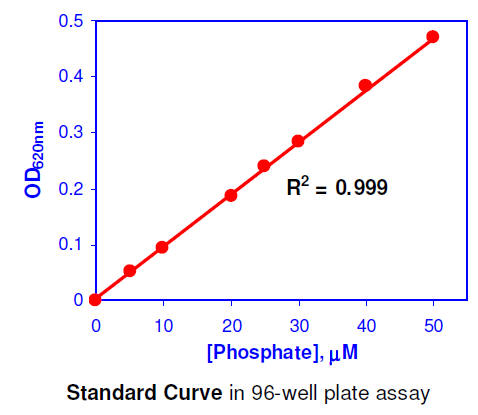
Linear detection range 0.30 μM (0.0028 mg/dL) to
50 μM (0.47 mg/dL) phosphate in 96-well plate
assay.
Simple and high-throughput.
The procedure involves addition of a single
working reagent and incubation for 30 min. Can
be readily automated as a high-throughput assay
for thousands of samples per day.
Improved reagent stability
and versatility. The optimized formulation
has greatly enhanced reagent and signal
stability. Assays can be executed in cuvet or
96-well plate.
Low interference in
biological samples. No pretreatments are
needed. Assays can be directly performed on raw
biological samples i.e., in the presence of
lipid, protein and minerals.
APPLICATIONS
Direct Assays:
Pi
in serum, urine, saliva, sweat, tissue culture
etc.
Drug Discovery/Pharmacology:
effects of drugs on Pi metabolism.
Food and Beverages: Pi
determination.
Environment: Pi
determination in water, soil and fertilizer.
KIT CONTENTS (500 tests in
96-well plates)
Reagent: 50 mL Pi standard:
14 mL 0.28 mg/dL (30
μM)
Blank Control: 14 mL
Storage conditions .
The kit is shipped at room temperature. Store
all components at 4°C. Shelf life of at least 6
months (see expiry dates on labels).
Precautions: reagents are
for research use only. Normal precautions for
laboratory reagents should be exercised while
using the reagents. Please refer to Material
Safety Data Sheet for detailed information.
PROCEDURES
Reagent Preparation:
Important: bring reagents to
room temperature and shake before use.
Procedure using 96-well
plate:
1. Set up standards and
samples. Transfer 50 μL distilled water
("Blank"), Standard and samples in duplicate
wells of a clear bottom 96-well plate.
2. Add 100 μL Reagent and tap
lightly to mix.
3. Incubate 30 min at room
temperature and read optical density at 620nm
(600-660nm).
Procedure using cuvette:
1. Set up test tubes labeled
Blank, Standard, Samples. Transfer 400 μL Water,
Standard and samples to appropriately labeled
tubes.
2. Add 800 μL Reagent and tap
lightly to mix.
3. Incubate 30 min at room
temperature, transfer to cuvet and read optical
density at 620 nm (600-660nm).
Important: (1) if sample
OD is higher than the OD for standard, dilute
samples in distilled water and repeat the assay.
(2) It is not necessary to prepare a calibration
curve, because the concentration of the provided
standard lies within the linear range. (3)
Precipitation may occur at high concentrations
of phosphate (>100 μM), or in the presence of
high concentrations of e.g. proteins and metals.
In this case, dilute samples in distilled water
and repeat the assay.
CALCULATION
The phosphate concentration
of Sample is calculated as

ODBLANK, ODSTANDARD
and ODSAMPLE are OD620nm values of
Blank, Standard and Sample, respectively.
Conversions: 1 mg/dL Pi
equals 105.3 μM, 0.001% or 10 ppm.
MATERIALS REQUIRED, BUT NOT
PROVIDED
Pipeting devices and
accessories.
Procedure using 96-well
plate:
Clear bottom 96-well plates
(e.g. Corning Costar) and plate reader.
Procedure using cuvette:
Spectrophotometer and cuvets
for measuring OD 620nm.
EXAMPLES (96-well plate
assay):
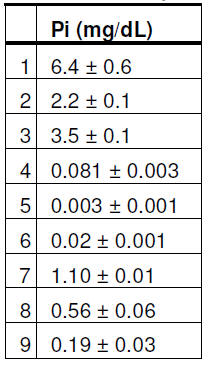
Biological Samples: 1.
Commercial 2% reduced fat milk (Kirkland). 2.
Invitrogen fetal bovine serum. 3. Fresh human
urine. Water samples: 4. Tap water (Hayward,
CA). 5. Tap water (San Bruno, CA). Food and
Beverages: 6. Crystal Geyser natural alpine
spring water. 7. Coca-cola® classic coke. 8.
Lipton Lemon iced tea. Environmental: 9. Soil
extract. 5.6 g of soil (Hayward, CA) was
extracted with 10 mL MilliQ water. The
supernatant was centrifuged to remove any
insoluble particles. Clear supernatant was
assayed.
PUBLICATIONS
1. Abranches, J. (2008). CcpA
regulates central metabolism and virulence gene
expression in Streptococcus mutans. J Bacteriol.
190(7):2340-9.
2. Hildebrand, J. et al
(2009) Functional and energetic characterization
of P-gp-mediated doxorubicin transport in
rainbow trout. Comp Biochem Physiol C Toxicol
Pharmacol. 149(1):65-72.
3. Dunbar, D.R. et al.
(2010). Transcriptional and physiological
responses to chronic ACTH treatment by the mouse
kidney. Physiol Genomics 40(3): 158-166. |
|
|
|
|
PiBlue TM
Phosphate Assay Kits (POPB-500)
DESCRIPTION
The PiBlueTM Phosphate Assay
Kit is based on a proprietary formulation of the
malachite green dye. The PiBlueTM reagent forms
a blue colored complex with free orthophosphate.
The rapid color formation from the reaction can
be conveniently measured on a spectrophotometer
(600 - 660 nm) or on a plate reader. The
non-radioactive colorimetric assay kits have
been optimized to offer superior sensitivity and
prolonged shelf life. The assay is simple and
fast, involving a single addition step for
phosphate determination. Assays can be performed
in tubes, cuvettes or multi-well plates. The
assays can be conveniently executed in 96-well
plates for highthroughput screening of enzyme
inhibitors.
KEY FEATURES
Reagent very stable .
Due to our innovative formulation, no
precipitation of reagent occurs. Therefore no
filtration of reagent is needed prior to assays,
as is often required with other commercial kits.
High sensitivity and wide
detection range: detection of as little of
20 pmoles of phosphate and useful range between
0.4 μM and 50 μM phosphate.
Fast and convenient:
single reagent “mix-and-measure” assay allows
quantitation of free phosphate within 30
minutes.
Compatible with routine
laboratory and HTS formats: assays can be
performed in tubes, cuvettes or microplates, on
spectrophotometers and plate readers.
Robust and amenable to HTS:
Z’ factors of 0.7 to 0.9 are observed in 96-
well plates. Can be readily automated on HTS
liquid handling systems.
APPLICATIONS
Phosphatase Assays :
liberation of phosphate from peptide, protein or
small molecule substrate.
Lipase Assays: liberation
of phosphate from phospholipids
Nucleoside Triphosphatase
Assays: liberation of phosphate from
nucleoside triphosphates (ATP, GTP, TTP, CTP
etc).
Quantitation of Phosphate
in phospholipids, proteins and DNAs, etc.
Drug Discovery:
high-throughput screen for phosphatase
inhibitors.

Storage conditions. The
PiBlueTM Reagent and standard is stable for 12
months when stored at 4°C.
Precautions: reagents are
for research use only. This reagent contains
0.44 M sulfuric acid. Normal precautions for
laboratory reagents should be exercised while
using the reagents. Please refer to Material
Safety Data Sheet for detailed information.
PROCEDURES
Procedure using 96-well
plate:
Important :
The reagent must be brought to room temperature
and well shaken before use. The PiBlueTM reagent
is highly sensitive to phosphate. It is
important that all enzyme preparations and assay
buffers not contain free phosphate. Lab
detergents may contain high levels of phosphate.
Make sure that lab wares are washed thoroughly
with distilled water and free from contaminating
phosphate.
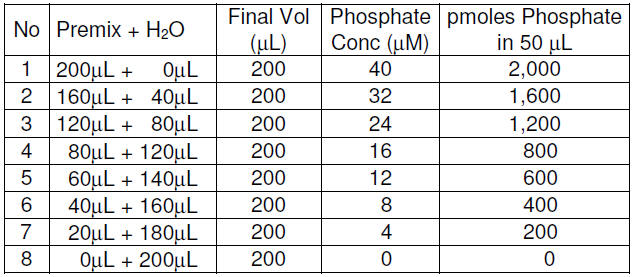
1. Dilution of phosphate
standards. Prepare a 1000 μL 40 μM phosphate
Premix solution by mixing 40
μL
1 mM phosphate standard with 960 μL distilled
water. Number the tubes. Prepare concentration
standards by diluting the Premix as shown in the
The phosphate concentrations in the tubes are
given below. Transfer 50 μL diluted standard in
duplicate to wells in a clear-bottom 96-
well plate. Store diluted standard at 4°C for
future use.
2. Transfer 50 μL test sample
(e.g. enzyme reaction) in duplicate into wells
of the microplate. In the case of enzyme
reactions, the reaction may be terminated by
either adding a specific inhibitor, or can be
stopped directly by the addition of the PiBlueTM
Reagent. Reaction buffer can be added as a blank
control for the samples.
3. Add 100 μL of the PiBlueTM
Reagent to each well. Mix by tapping the plate.
4. Incubate for 30 min at
room temperature for color development.
5. Measure absorbance at 620
nm (600 nm - 660nm) on a plate reader.
Procedure using Cuvette:
For cuvette assays, add 800
μL Reagent to 400 μL sample and standards.
Perform the assay as described for the
microplate assay.
GENERAL CONSIDERATIONS
Incubation time .
The chromogenic reaction is completed within 30
min.
Precipitation may occur
at high concentrations of phosphate (>100 μM),
or in the presence of high concentrations of
e.g. proteins and metals. If precipitation
occurs, dilute samples in distilled water and
repeat the assay.
Enzyme reaction buffer.
Because any exogenous free phosphate would
interfere with the assay, it is important to
ensure that the protein preparation, the
reaction buffer and lab wares employed in the
assay should not contain free phosphate. This
can be conveniently checked by adding the
Reagent to the buffer and measuring the color
formation.
DATA ANALYSIS
Plot pmoles phosphate versus
OD620nm for the standard curve. Use linear
regression analysis to determine amount of free
phosphate in the test samples.
LITERATURE
High-throughput Screening
1. Rumsfeld J, Ziegelbauer K,
Spaltmann F (2000). High-throughput assay for
inorganic pyrophosphatases using the cytosolic
enzymes of Saccharomyces cerevisiae and human as
an example. Protein Expr Purif. 18(3):303-9.
2. Cogan EB, Birrell GB,
Griffith OH (1999). A robotics-based automated
assay for inorganic and organic phosphates. Anal
Biochem. 271:29-35.
3. Ng DH, Harder KW,
Clark-Lewis I, Jirik F, Johnson P (1995).
Nonradioactive method to measure CD45 protein
tyrosine phosphatase activity isolated directly
from cells. J Immunol Methods. 179(2):177-85.
4. Fisher DK, Higgins TJ
(1994). A sensitive, high-volume, colorimetric
assay for protein phosphatases. Pharm Res.
11(5):759-63.
Assays for phosphatases,
lipases/phospholipids, nucleoside
triphosphatases and phosphate in proteins and
DNAs. |
|
|
|
|
Malachite Green Phosphate
Assay Kits (POMG-25H)
Rapid Colorimetric Phosphate
Determination at 620 nm
DESCRIPTION
The Malachite Green Phosphate
Assay Kit is based on quantification of the
green complex formed between Malachite Green,
molybdate and free orthophosphate. The rapid
color formation from the reaction can be
conveniently measured on a spectrophotometer
(600 - 660 nm) or on a plate reader. The
non-radioactive colorimetric assay kits have
been optimized to offer superior sensitivity and
prolonged shelf life. The assay is simple and
fast, involving a single addition step for
phosphate determination. Assays can be executed
in tubes, cuvettes or multi-well plates. The
assays can be conveniently performed in 96- and
384-well plates for high-throughput screening of
enzyme inhibitors.
KEY FEATURES
Reagent very stable .
Due to our innovative formulation, no
precipitation of reagent occurs. Therefore no
filtration of reagent is needed prior to assays,
as is often required with other commercial kits.
High sensitivity and wide
detection range: detection of as little of
1.6 pmoles of phosphate and useful range between
0.02 μM and 40 μM phosphate.
Fast and convenient:
homogeneous “mix-and-measure” assay allows
quantitation of free phosphate within 20
minutes.
Compatible with routine
laboratory and HTS formats: assays can be
performed in tubes, cuvettes or microplates, on
spectrophotometers and plate readers.
Robust and amenable to HTS:
Z’ factors of 0.7 to 0.9 are observed in 96-
well and 384-well plates. Can be readily
automated on HTS liquid handling systems.
APPLICATIONS
Phosphatase Assays :
liberation of phosphate from peptide, protein or
small molecule substrate.
Lipase Assays: liberation of
phosphate from phospholipids
Nucleoside Triphosphatase Assays:
liberation of phosphate from nucleoside
triphosphates (ATP, GTP, TTP, CTP etc).
Quantitation of Phosphate in
phospholipids, proteins and DNAs, etc.
Drug Discovery:
high-throughput screen for phosphatase
inhibitors.
KIT CONTENTS: 2,500 ASSAYS IN
96-WELL PLATE
Reagent A :
50 mL Reagent B: 1 mL Standard:
1mL 1 mM phosphate
Storage conditions. The
reagents and standard are stable for one year
when stored at 4°C.
Precautions: reagents are
for research use only. Normal precautions for
laboratory reagents should be exercised while
using the reagents. Please refer to Material
Safety Data Sheet for detailed information.
PROCEDURE USING 96-WELL PLATE
Reagent Preparation.
Each assay requires 20 μL Working Reagent.
Prepare enough Working Reagent by mixing 100 vol
of Reagent A and 1 vol of Reagent B (e.g. 5 mL
Reagent A and 50 μL Reagent B). Working Reagent
is stable for at least 1 day at room
temperature.
Important: The reagent must be brought to
room temperature before use. Before each assay,
it is important to check that all enzyme
preparations and assay buffers do not contain
free phosphate. This can be conveniently done by
adding 20 μL of the Working Reagent to 80 μL
sample solution. The blank OD values at 620 nm
should be lower than 0.2. If the OD readings are
higher than 0.2, check water phosphate level.
Double distilled water usually have OD readings
lower than 0.1. Lab detergents may contain high
levels of phosphate. Make sure that lab wares
are free from contaminating phosphate after
thorough washes.
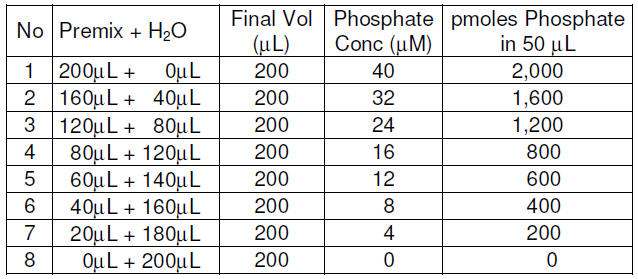
1. Preparation of phosphate
standards. Prepare a Premix solution containing
40 μM phosphate by pipetting 40 μL 1 mM
phosphate standard to 960 μL distilled water or
enzyme reaction buffer. Number the tubes. Dilute
standards as shown in the following Table.
Pipette 80
μL standard
in duplicate into wells of a clear-bottom
96-well plate. Add blank controls containing
water or reaction buffer only.
2. Transfer 80 μL test samples
into separate wells of the plate.
Note: in the case of enzyme
reactions, the reaction may be terminated by
adding a specific inhibitor, or can be stopped
directly by the addition of the Working Reagent.
Dilution of reaction mixture may be necessary
prior to the assay (see General Considerations).
For ATPase or GTPase assays, the ATP or GTP
concentration should be lower than 0.25 mM. If
the reaction mixture contains > 0.25mM ATP or
GTP, dilute samples in distilled water. For
example, if the ATPase reaction contained 1 mM
ATP, at the end of reaction dilute reaction
mixture 4-fold in water prior to the assay.
3. Add 20 μL of Working Reagent
to each well. Mix gently by tapping the plate.
4. Incubate for 30 min at room
temperature for color development.
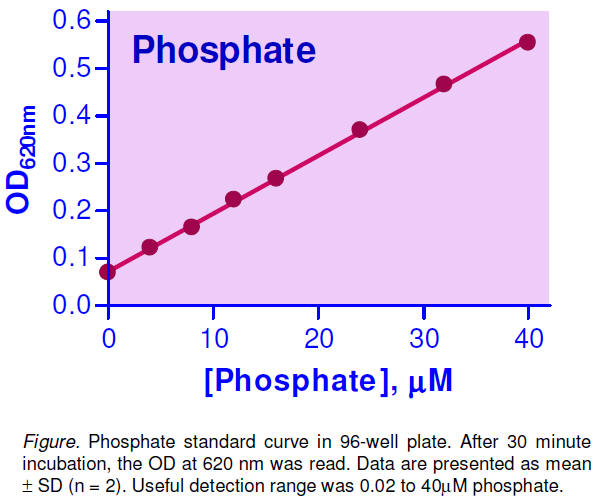
5. Measure absorbance at 600 nm
- 660nm (620 nm) on a plate reader. For assays
in 384-well plates, the procedures are the same,
except that the volume of the standard and
sample solution should be 40 μL and that of the
Working Reagent should be 10 μL.
GENERAL CONSIDERATIONS
Incubation time .
The chromogenic reaction is completed within 30
min at room temperature. Read OD values at 30
min.
Precipitation may occur at
high concentrations of phosphate (>100 μM), or
in the presence of high concentrations of e.g.
proteins and metals. |
|
|
|
|




















 日本
日本