|
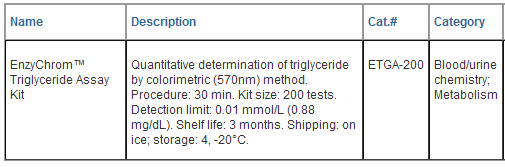
EnzyChromTM Triglyceride Assay Kit (Cat#
ETGA-200)
Quantitative Colorimetric Triglyceride
Determination at 570nm
DESCRIPTION
TRIGLYCERIDE, also known as
TRIACYLTRIGLYCERIDE or TRIACYLGLYCERIDE, is the main constituent
in vegetable oil and animal fats. Triglycerides play an
important role as energy sources and transporters of dietary
fat. In the human body, high levels of triglycerides in the
bloodstream have been linked to atherosclerosis, heart disease
and pancreatitis. Simple, direct and automation-ready procedures
for measuring triglyceride concentrations find wide applications
in research and drug discovery. BioAssay Systems' triglyceride
assay uses a single Working Reagent that combines triglyceride
hydrolysis and glycerol determination in one step, in which a
dye reagent is oxidized to form a colored product. The color
intensity at 570nm is directly proportional to triglyceride
concentration in the sample.
KEY FEATURES
Sensitive and
accurate.
Use as little as 10 μL samples. Linear detection
range
0.01 mmol/L to 1.0 mmol/L (0.88 mg/dL to 88.5 mg/dL)
triglyceride.
Simple and convenient. The procedure
involves addition of a single working reagent and incubation for
30 min at room temperature, compatible for HTS assays.
Improved reagent stability. The
optimized formulation has greatly enhanced the reagent and
signal stability.
APPLICATIONS:
Direct Assays:
triglyceride in biological samples (e.g. serum and plasma).
Drug Discovery/Pharmacology: effects
of drugs on triglyceride metabolism.
KIT CONTENTS
Assay Buffer:
24 mL
ATP: 250 μL Dye Reagent: 220 μL
Enzyme Mix:
500 μL Lipase: 1000 μL
Standard:
100 μL (equivalent to 100 mmol/L Triglyceride)
Storage
conditions. The kit is shipped on dry ice. Store Assay
Buffer at 4°C and other reagents at -20°C. Shelf life of three
months after receipt.
Precautions:
reagents are for research use only. Normal precautions for
laboratory reagents should be exercised while using the
reagents. Please refer to Material Safety Data Sheet for
detailed information.
PROCEDURES
Note: (1)
SH-group containing reagents (e.g. mercaptoethanol, DTT) may
interfere with this assay and should be avoided in sample
preparation; (2) if sample contains glycerol, use BioAssay
Systems' EnzyChromTM Glycerol Assay Kit (Cat# EGLY-200) to
determine glycerol concentration and subtract the glycerol value
to yield triglyceride concentration.
1. Equilibrate all
components to room temperature. Keep thawed Lipase and Enzyme
Mix in a refrigerator or on ice. Dilute Standard in distilled
water as follows. Transfer 10 μL diluted standards into wells of
a clear
96-well
plate. Diluted standards can be used for future assays when
stored refrigerated.

Serum and plasma
samples should be diluted 5-fold in dH2O and are assayed
directly. Cells and other solid samples can be solubilized in 5%
Triton X-100 (see
Ref. 3). Transfer 10 μL
samples into separate
wells
of the 96-well plate.
2.
Prepare Working Reagent for each well, by mixing 100
μL
Assay
Buffer,
2 μL
Enzyme Mix, 5
μL
Lipase, 1 μL
ATP and 1 μL
Dye
Reagent
in a clean tube. Transfer 100
μL
Working Reagent into
standards and sample wells. Tap plate to mix.
3.
Incubate 30 min at room temperature. Read optical density at
570nm (550-585nm).
Note:
1. if the Sample OD is higher than the Standard OD at 1.0
mmole/L triglyceride, dilute sample in water and repeat the
assay. Multiply by the dilution factor
n.
CALCULATION
Subtract
ODH2O (water, #4) from the standard OD values and plot the OD
against standard concentrations. Determine the slope using
linear regression fitting. The triglyceride concentration of
Sample is calculated as

ODSAMPLE
and ODH2O
are optical density values of the sample and the water blank (#
4). n
is the
dilution factor. For example serum or plasma samples are diluted
5-fold prior to assay,
n = 5.
Conversions: 1 mmol/L triglyceride equals 88.5 mg/dL or 10
ppm.
MATERIALS REQUIRED, BUT NOT PROVIDED
Pipeting devices, centrifuge tubes, clear
flat bottom 96-well plates (e.g. Corning Costar) and plate
reader.

LITERATURE
1. Nägele U et al (1984). Reagent for the
enzymatic determination of serum total triglycerides with
improved lipolytic efficiency. J Clin Chem Clin Biochem.
22(2):165-74.
2. Bucolo, G. and David, H. (1973).
Quantitative determination of serum triglycerides by the use of
enzymes. Clin. Chem.19(5): 476-482.
3. Zhu Y et al (2000). Genomic interval
engineering of mice identifies a novel modulator of triglyceride
production. PNAS 97(3): 1137-1142.
|





















 GENTAUR Germany
Marienbongard 20
GENTAUR Germany
Marienbongard 20
 GENTAUR Italy
 Česká republika
Praha
Česká republika
Praha Danmark
 Finland Helsset
 Ελλάς Αθήνα
 Ireland Dublin
 Luxembourg
 Magyarország
Budapest
Magyarország
Budapest Nederland
 Norge
Oslo
Norge
Oslo Österreich
 Sverige
Stockholm
Sverige
Stockholm Schweiz Züri
 Canada Montreal
 US New York
 日本
日本