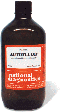
Autofluor
represents the first water soluble scintillation phosphor to be
developed and applied directly for use as an autoradiographic image
intensifier. Autofluor rapidly penetrates acrylamide gel systems and
maximizes energy transfer from labeled compound to phosphor.
Autofluor contains no dimethylsulfoxide or acidic aromatic solvents.
Therefore, the hazards of use related to these materials are
eliminated. The band distortion that is associated with using
nonaqueous enhancers is also eliminated.
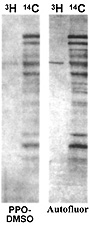
In the figure at right, the gel on the left (7%, 1mm) was
dehydrated in DMSO (dimethylsulfoxide) for one hour, then
impregnated in PPO-DMSO for one hour and precipitated and dried. The
right gel was impregnated with Autofluor for one hour and dried.
Both gels were exposed for 24 hours at -76°C on Kodak XR-5 X-OMat
film. The single tritiated band contains 5000 dpm. Note the higher
degree of resolution and band discrimination with Autofluor vs
PPO-DMSO.
The Autofluor procedure is the shortest and easiest procedure yet
developed for enhancement and visualization of beta-emitters. In an
independent test comparing eight different fluorographic methods for
the detection of
35S-labeled proteins in
polyacrylamide gels, Autofluor was the most effective. With
Autofluor, the dpm/mm2 required to half-saturate the x-ray film was
1/8 that required by autoradiography alone.
Storage: Autofluor has a shelf life of at least one year stored at
room temperature, out of direct sunlight. Keep from freezing. At
temperatures less than 20°C precipitation of water soluble phosphors
may occur. Warming to approximately 30°C will redissolve the
phosphors.





















 GENTAUR Germany
Marienbongard 20
GENTAUR Germany
Marienbongard 20
 GENTAUR Italy
 Česká republika
Praha
Česká republika
Praha Danmark
 Finland Helsset
 Ελλάς Αθήνα
 Ireland Dublin
 Luxembourg
 Magyarország
Budapest
Magyarország
Budapest Nederland
 Norge
Oslo
Norge
Oslo Österreich
 Sverige
Stockholm
Sverige
Stockholm Schweiz Züri
 Canada Montreal
 US New York
 日本
日本