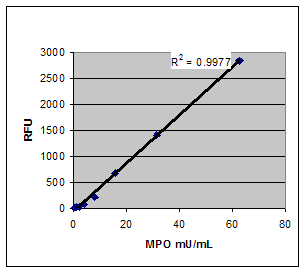
Can monitor multiple time points to follow
kinetics.
One-step, no wash assay.
Adaptable for High Throughput format
Highly Sensitive
Applications - Fluorescence (Plate
Reader) or Absorbance
Assay Principle
Myeloperoxidase (MPO) is a highly cationic
glycosolated hemoprotein that has a molecular weight
of 144kD. The hemoprotein consists of two dimers
linked via a disulfide bridge. Each dimmer is
composed of a heavy (53kD) and light (15kD) subunit.
Each heavy chain contains an independently acting
protoporphyrin group containing a central iron
(1-5). MPO is present in the azurophilic
granules of polymorphonuclear leukocytes (PMNs) and
is unique to neutrophils and monocytes. However,
monocytes contain only one third of the MPO found in
PMN’s. MPO utilizes H202 produced by the neutrophils
to oxidize a varity of aromatic compounds to give
substrate radicals for bactericidal activity (4
review). This enzyme is unique however in that
it can oxidize chloride ions to produce a strong
nonradical oxidant,HOCl. HOCl is the most powerfull
bactericidal produced by neutrophils (4 review).
Excessive production of these radicals can cause
oxidative stress leading to oxidative tissue injury.





















 GENTAUR Germany
Marienbongard 20
GENTAUR Germany
Marienbongard 20
 GENTAUR Italy
 Česká republika
Praha
Česká republika
Praha Danmark
 Finland Helsset
 Ελλάς Αθήνα
 Ireland Dublin
 Luxembourg
 Magyarország
Budapest
Magyarország
Budapest Nederland
 Norge
Oslo
Norge
Oslo Österreich
 Sverige
Stockholm
Sverige
Stockholm Schweiz Züri
 Canada Montreal
 US New York
 日本
日本