| To determine SOD activity, several direct
and indirect methods have been developed. A common and
convenient indirect method utilizes nitroblue tetrazolium (NBT)
conversion to NBT-diformazan (formazan dye) via superoxide
radical. However, there are several disadvantages to the NBT
method, such as poor water solubility of the formazan dye and
the interaction with the reduced form of xanthine oxidase.
Though cytochrome C is also commonly used for SOD activity
detection, its reactivity with superoxide is too high to
determine low levels of SOD activity. Cell Technology’s
SOD kit utilizes a water-soluble tetrazolium salt, WST-1
(2-(4-Iodophenyl)- 3-(4-nitrophenyl)-5-(2,4-disulfophenyl)-
2H-tetrazolium, monosodium salt) that produces a highly
water-soluble formazan dye upon reduction with a superoxide
anion (6). The rate of the reduction with O2.-
is linearly related to the xanthine oxidase (XO) activity, and
is inhibited by SOD, as shown in Figure 1. Therefore, the IC 50
(50% inhibition activity of SOD or SOD-like materials) can be
determined by this colorimetric method. Absorbance can be
measured at 440nm.
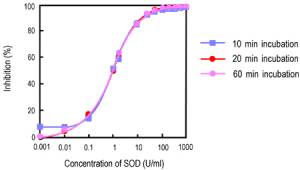
Figure 1 - Inhibition Curve
Prepared Using SOD from Bovine Liver
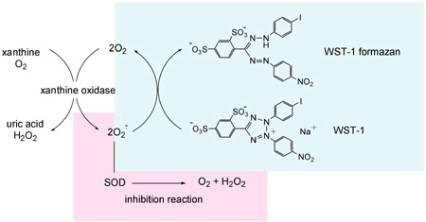
Figure 2 - SOD ASSAY Reaction
|





















 GENTAUR Germany
Marienbongard 20
GENTAUR Germany
Marienbongard 20
 GENTAUR Italy
 Česká republika
Praha
Česká republika
Praha Danmark
 Finland Helsset
 Ελλάς Αθήνα
 Ireland Dublin
 Luxembourg
 Magyarország
Budapest
Magyarország
Budapest Nederland
 Norge
Oslo
Norge
Oslo Österreich
 Sverige
Stockholm
Sverige
Stockholm Schweiz Züri
 Canada Montreal
 US New York
 日本
日本